

May 7, 2026 Submitted by Beth Rouleau, Member of the Center for Active Living Building Committee
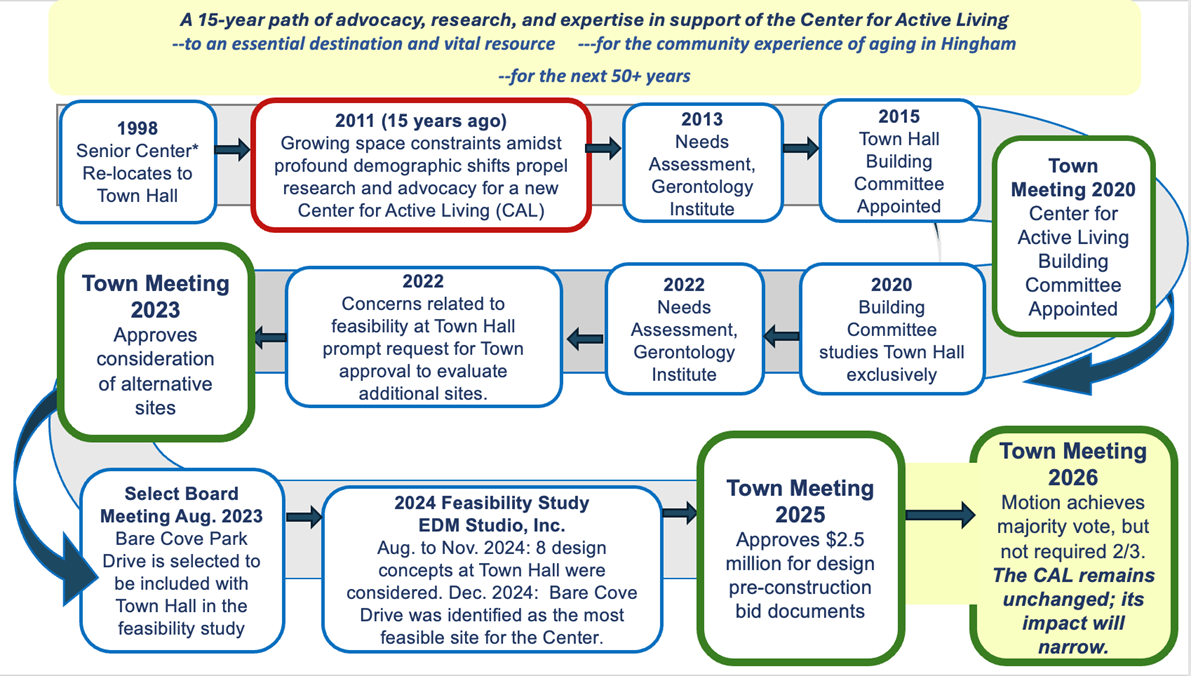
The CAL remains unchanged and its impact on the community will continue to narrow. The highly informed guiding path in support of the CAL remains.
Submitted by Beth Rouleau, Vice Chair, Center for Active Living Building Committee; former Chair, Council on Aging (COA), 2012-2018, MS Gerontology
Despite tireless efforts and an extraordinary amount of research in support of aging in Hingham, Town Meeting 2026 became a milestone of disappointment, instead of celebration in the CAL’s 55-year history. A long-awaited opportunity to build a “better center”, a fixture in our healthcare network, is delayed, fate unknown.
Every project carries considerations from different perspectives. Please rely on the 15-year path, and an expansive accumulation of research and expertise (environmental, legal, architectural, community planning) as a solid foundation in support of the CAL’s future.
- Over the last 5 years the Building Committee heard a solid repeated refrain, Hingham needs a better Center for Active Living, a heartfelt sentiment that has been shared by many since 2011.
- The solution presented at Town Meeting was formed over 15 years through countless hours of dedication among hundreds of volunteers and town leaders; legal, environmental, architectural, and planning experts; two needs assessments and a feasibility study; and hundreds of public meetings.
- The solution was also supported by Town Meetings 2020, 2023; and again in 2025 when $2.5 million was approved to support the final design and pre-construction phase for the CAL to be built off Bare Cove Park Drive (in a small share (~1%) of the recreation area acquired by the town through the Federal Land to Parks program in 1972).
- 2025 Town Meeting support for the CAL project was obtained prior to reductions in the size (10%) and cost of the building (down ~18%). $2.5 million is now a sunk cost.
- I’ve heard something better and less expensive exists. That hasn’t been uncovered in 15 years. While the financial costs of waiting have been calculated and demonstrated in a growing list of communities, the costs of waiting that are associated with community health are both measurable, and sadly, invisible.
- If another solution exists, when –where– and at what increase in costs, visible and invisible?
Today, the foundation of the current Center remains fragile and the Center’s impact on our community will continue to narrow as the population grows.
- In contrast to the fragile CAL, a 15-year planning path, fortified by advocacy, research, investment, and expertise will remain solidly in place in Hingham’s history.
- I’m writing to express my sincere gratitude for the comprehensive planning process that I witnessed over 15 years, and the dedication and expertise of countless individuals who contributed their time and expertise to the CAL project; and importantly, I want to elevate the essentials of what we sought to convey during public meetings, presentations, and information sessions over several years – the key takeaways shared in the past are critical for clarity and context in support of the CAL’s future.
This is not a transient demographic peak. The share of the older population will continue to grow in the coming years and remain large for decades.
- Hingham’s 60+ population is approaching the largest category assigned by the Executive Office of Aging and Independence, 10,000 + residents over age 60.
- Hingham, with 32% of residents over age 60 is in the top 1/3 of 351 communities across MA that have a large share (over 30%) of residents age 60+. (The list includes communities with the highest concentrations of older residents (Cape Cod, Martha’s Vineryard, and the Berkshires) where the share of residents age 60+ exceeds 50%. The State average is 23.78%.
- According to projections, the share of residents age 60+ will increase during the 2030s and remain at a stable high share for decades, during the life of the proposed Center, and the country’s era of aging.
- Larger communities require larger resources and have larger tax bases to support needs. With Hingham’s growing population (close to 25,000 residents), new residential development has grown. Hingham’s 2021 Housing Plan reports housing inventory increased by close to 2,000 units (of 9,152) between 2000 and 2017; the Housing Plan states resources will be required to support new development.
- The building was built at a smaller scale than suggested guidelines of the MA Executive Office of Aging and Independence. At 25,950 SF, the proposed Center is close to 10,000 SF less than the minimum guideline when 4 sq. ft. is applied to the projected population of 9,000+ Hingham residents age 60+, suggesting at least 36,000 square feet.
- While not designed with the expectation of 9,000+ residents age 60+* participating at the Center, we don’t know when we will meet a need or crisis for which the CAL exists. As well, the CAL’s dedicated staff and network of partners exist not only for in person engagement, but as a supportive hub for remote services (e.g. tax relief programs, information and referrals, transportation, home delivered meals, and caregiver support.) * Projection for 2030+.
The design was not inflated to accommodate Linden Ponds.
- Linden Ponds was included in the analysis because its residents are members of our community.
- Linden Ponds was also excluded from analysis following concerns that the design was inflated. (Note: we did not remove smaller senior housing properties from other peer communities but did so in Hingham to demonstrate the reasonable scale of the building without Linden Ponds.)
- The Building Committee removed Linden Ponds to demonstrate that the building is reasonably scaled and would still be proportionally smaller than towns included in the South Shore peer analysis when calculated with projected growth in the 60+ population. With 2025 data, the proposed CAL will be smaller than the 2025 average SF/ resident 60+ that was calculated for the Centers in Cohasset, Duxbury, Marshfield, and Scituate. Each of those town emphasized the need for more space to accommodate their (smaller than Hingham’s) 60+ populations. Please refer the Building Committee’s report on the Town website (Exhibit F).
- Please note, individuals who reside in skilled nursing facilities were not included in the analysis. Those properties are included in a separate calculation made by the U.S. census bureau.
- In comparing the gross square footage of the current and proposed Centers it is important to consider requirements of a new building. The proposed CAL must allocate space for mechanical, utility, and storage spaces that are not included in the current CAL’s square footage. As well, every new or retrofitted center requires square footage and features that respond to ADA and energy compliance; the functional and circulation spaces are scaled at a higher square footage than minimum building code to be accessible, supportive, and inclusive for diverse needs (wider hallways with seating, and increased clearances in programming spaces.
Peer community comparisons require context. Every community has unique demographic features as well as a range of resources that respond to needs.
- Comparisons to other centers must be made with proportionate calculations and historical context to demonstrate that the proposed CAL is not the largest Center among peer communities. Larger populations need larger buildings. Towns with large scale complementary programming resources (e.g. large-scale recreation/fitness complexes, aquatic centers) require balanced scale across multiple buildings). Centers that were built years ago (Wellesley 2017, Cohasset 2014) were less expensive. Delays in projects are resulting in $1.5 million+ in cost increases per year.
Amidst strong agreement during public discussions that a larger Center is necessary in Hingham, genuine cost concerns have been shared. The CAL is a vital resource that exists to respond to challenges and hardship by providing affordable services and programs that are associated with improved health status, quality of life, and financial security.
- When we acknowledge the needs identified in the survey of the 2022 Community Needs Assessment*, including financial insecurity, caregiver needs, and needs related to chronic disease, it is critical to collectively recognize the responsive recommendations of the report in support of the development of essential community based resources; an adequate Center for Active Living is a foundation for those initiatives. See excerpts below. (* The Needs Assessment included a sample survey of 5, 000 residents age 45+.)
“The physical space and location of the Hingham Senior Center does not currently meet the needs of the range of ages and interests of the Hingham older adult population and is far smaller than the spaces occupied by its peers….The Hingham Senior Center is the only one of its 6 peers that has not invested in a new senior center space or renovation of existing space; and it currently occupies the least amount of space—even with comparable size populations of older adults.”
“That the older population of Hingham is already large and will continue to expand—makes clear the importance of considering how well features of the Town, the services and amenities available, and virtually every aspect of the community align with the age demographic moving forward.”
Hingham’s CAL is an economical form of preventative healthcare –healthcare costs, and other costs of living are closely intertwined with financial insecurity. Research has grown to demonstrate the impact of an adequate Center in promoting independence, quality of life, and generating improved health outcomes —yielding cost savings for residents, the community, and our healthcare system. Please refer the Building Committee’s report on the Town website (Exhibit B) for a summary of the CAL’s response to demographic features and needs in the community.
The proposed CAL will support the community experience of aging across generations, including caregivers and remote family members. A CAL is unique in its role as an accessible hub for connections across generations, fostered through intergenerational programming and multigenerational uses. With far reaching impact, operating budgets of Centers in MA are relatively small, often under 1% of a municipal budget – with multiple funding sources including formula grant funding and self-sustaining activities.
The impact of the CAL is heightened by a location that offers synergy, and care and protection for both residents and the environment. The pre-disturbed site was reviewed by the National Park Service, the Massachusetts Executive Office of Energy and Environmental Affairs, and the Massachusetts legislature. The proposed CAL elevates opportunities for the community of Hingham to leverage the guidance of National Park Service in continuing to develop programs and practices that foster environmental stewardship through community partnerships, education, and volunteerism. The site also offers opportunities to improve accessibility to Bare Cove Park and to expand indoor and outdoor evidence-based programming (e.g. see the SHAPR Initiative: Supporting Healthy Aging Through Parks and Recreation initiative funded by the CDC and managed by the National Recreation and Park Association (NRPA).
With gratitude, I want to recognize the volunteers, dedicated CAL staff, and Town leaders that supported the informed path to April 27, 2026. Thank you Hingham residents, fellow Building Committee members, Council on Aging (COA) members, Friends of the COA, Town Boards and Committees – including the Select Board, Advisory Committee, Planning Board, and Zoning Board of Appeals; and the design team led by EDM Studio, with LifeSpan Studio; and P3.
I also want to recognize the family and friends of volunteers (individuals on committees and boards, and in roles that are invisible) who supported the supporters’ absence during uncountable hours and late-night meetings, in support of the project and the community of Hingham.
Finally, I heard from many who described their dismay following the outcome at Town Meeting, and I heard from those who are frustrated with barriers to participation at Town Meeting. A historic decision was made by 980 residents at Town Meeting 2026. Together we can strive for changes to foster inclusion and higher levels of participation during consequential decision making for community planning initiatives.
15 years…We have reached a straightaway – please stay the path of research and expertise in support of the CAL’s future.
This project matters.