

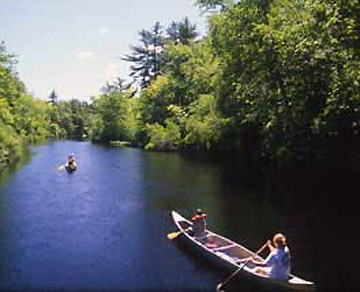
September 9, 2026 Submitted By John Borger (Picture of the Ipswich River from https://historicipswich.net)
The Ipswich River begins in Burlington, MA and winds its way 45 miles to Plum Island Sound, Ipswich Bay, and the Atlantic Ocean. It sustains the Mass Audubon Society’s splendid Ipswich River Wildlife Preserve in Topsfield and provides the main source of drinking water for 350,000 people in 14 communities, including Topsfield, Hamilton, Wenham, and Ipswich. These are beautiful old North Shore towns similar to Hingham in property values and upscale cache. In the Summer of 1985, the 14 towns that pump water from the river-fed aquifer almost killed the Ipswich River. The collective, sustained force of multiple towns’ well pumps simultaneously wringing out the subsiding aquifer in futile attempts to satisfy lawn irrigation demand during a summer drought literally sucked the river dry. In many previously verdant stretches, the suddenly-parched riverbed became a desiccated, cracked shell. There was a massive fish die-off. The American Rivers organization ranked the Ipswich River #8 on its list of the most endangered rivers in America. Public outrage was visceral, and state government was forced to react to this shocking tragedy of the commons. In 1986, the state legislature passed the Massachusetts Water Management Act (WMA), giving the Department of Environmental Protection (MassDEP) comprehensive oversight over local water authorities and formidable enforcement tools.
MassDEP Adult Supervision
Newly empowered, MassDEP shelved its polite appeals for conservation. It initiated regularly scheduled measurements of the flow volumes of key watersheds in cubic feet per second and ongoing calculations of how much water local authorities could sustainably draw. It implemented WMA permits with strict quotas for water systems, explicitly matching a town’s pumping rights to local streamflow, with onerous penalties for violations.
Complementing its regulation of local water authorities, MassDEP also began to monitor state-wide drought conditions and developed successively stepped conservation mandates corresponding to drought severity. (Hingham’s Level II outdoor watering bans come from MassDEP’s legally binding permit conditions tied to drought conditions declared for the state’s Southeast Region.)
The WMA vested MassDEP with compelling enforcement mechanisms:
• Onerous Penalties – If a town pumps enough to threaten local water levels, MassDEP can impose mandatory water bans and staggering financial penalties. Substantial daily over-pumping or willful non-compliance can trigger fines of up to $25,000 per day per violation.
• No-Pass-Through – The WMA’s “No-Pass-Through” rule forbids water departments from funding Mass DEP fines by simply increasing rate payers’ water bills; the money must come from the water department’s existing operating budget or from municipal reserves, if necessary.
• Receivership– If warranted, MassDEP can force the town into an Administrative Consent Order (ACO), effectively state receivership for the water company, under which the state takes partial control of local decision-making.
An ACO can dictate a range of local actions, such as enforcing immediate, 100% outdoor water bans, installing mandatory smart-meters on every home, or filing weekly usage reports.
• Cascading Fines – If a town misses a single deadline, multiple fines suspended on presumption of compliance can be activated, which could mean thousands of dollars immediately assessed for every week a mandated project is delayed or a quota is exceeded.
• Revoked WMA Permits – If a town continuously flouts its quotas, MassDEP can suspend or revoke the water system’s WMA withdrawal permit entirely, which means the town no longer has the right to extract water. The town must then buy water from neighboring systems on an emergency basis at premium rates, risking a municipal fiscal catastrophe.
• Moratoriums on New Connections – If a water system exceeds its safe yield quota, MassDEP can impose a total moratorium on new water main extensions and service connections, freezing local development. This nullifies a town’s efforts to broaden its tax base through economic development – an explicit goal of Hingham Town government.
• Criminal Penalties and Injunctive Relief – In extreme cases of environmental negligence—where a water board knowingly over-pumps, misreports data, or willfully drains a protected stream—the MassDEP can seek criminal penalties against individual operators or board officials. This can include personal fines or even jail sentences of up to 2.5 years.
State Controls Proved Essential
Some may decry MassDEP’s WMA-granted power as massive state intrusion into local autonomy. But remember – we had a searing, “never again” episode with the Ipswich River. The Commonwealth was forced to intervene in what had become a local, Wild West race literally to the bottom. It took the political heft of Senate President William Bulger and House Speaker George Keverian to ram the WMA through the legislature, overcoming fierce resistance from municipal water departments.
The Ipswich River catastrophe wasn’t perpetrated by ecoterrorists committing malicious vandalism on a grand scale. No, this was the result of well-intentioned local water officials trying to accommodate seasonal lawn irrigation. They found themselves caught in a destructively competitive “collective action” trap – who would dare be the first to reverse course, curtail pumping and anger local irrigators? Together, they almost killed a magnificent river.
The Takeaway for Hingham
This tragedy of the commons does not have a happy ending. Rather, it’s an object lesson for towns like Hingham, driving home that our water sources have finite limitations we exceed at our peril. The aquifers of the Ipswich River and Weir River watersheds are almost identical – shallow repositories composed mostly of sand and gravel deposited by retreating glaciers. Neither aquifer is fed by mountain snowmelt, huge lakes, or reservoirs like Quabbin; both depend on rain and snow for regular recharge. Both are highly porous and have low overall capacity; when fully saturated by rain, additional precipitation (as forecast for the coming “super El Nino” winter) simply runs off the surface soil into the Atlantic Ocean. Powerful municipal well pumps draining a subsiding aquifer can suction whole rivers and ponds dry. Once discharged past a critical level, this kind of aquifer can take decades to recharge; a single dry summer can undo years of progress. Because 14 towns had to continue to draw from the Ipswich River watershed, long stretches of the river dried up entirely in 1995, 1997, 1999, 2002, 2005, and 2016.
Echoing the “wound” analogy used by Wayne Castonguay, Executive Director of the Ipswich River Watershed Association, Hunt Durey, a regional conservation leader, noted at a watershed summit that the Ipswich serves as a dire warning for other towns:
“The Ipswich River is wounded and suffers severe injury almost every year. This is not a doom-and-gloom exaggeration. This is the reality of the here and now. It’s the same reality looming on the horizon for many other rivers.”
Activating The Conservation Imperative
The Ipswich River crisis shifted the perspective of North Shore water managers from “how do we pump more water?” to “how do we stop people from wasting it?”
One strategy many of them deployed uses the universally recommended approach I have called upon our WRWS Commissioners to initiate: the application of basic economics, through volume-driven, tiered rates.
• Multiple watershed towns (including Topsfield, Wenham, and nearby Manchester) moved to sharply ascending, tiered pricing. The first volume tier (covering basic indoor needs) is priced relatively low. If a property crosses into higher tiers of consumption, the higher volume user pays steeply increasing rates.
• The Town of Ipswich enacted a variation aimed squarely at seasonal irrigation – the Summer Residential Rate. From May 1 to September 30, the cost per 100 cubic feet of water (CCF) spikes significantly compared to the rest of the year. The winter rate is $8.50 per CCF; the summer rate is 2.3 times higher, $19.94 per CCF! This keeps normative usage for indoor household necessities still relatively affordable, but imposes high costs for luxury, non-essential summer uses like irrigation, incentivizing conservation.
Summary
Demanding that WRWS pump more water for lawns during a Level II drought is the very opposite of being a responsible citizen and a good steward. It is also tantamount to suborning violation of Massachusetts law. It cavalierly flouts the community imperative for conservation of this precious resource we hold in common. Even if you can legally draw from a private well to irrigate grass, you are still taking more than your fair share of water from the same fragile aquifer that must sustain us all. Regardless of intent or means of access, people who persist in using excessive volumes of shared water perpetuate Hingham’s tragedy of the commons. We must take common-sense steps to bring the curtain down on that tragedy. The WRWS Board of Water Commissioners must lead the way; ratepayers must follow. The future of our aquifer – and the Town – depends on it.
– John Borger
Coming in Hingham H2O – The Clear and Present Danger – What If a WRWS Pump Fails?