
April 16, 2026 Submitted by Beth Rouleau, Member of the Center for Active Living Building Committee
“Growing Up” and Aging as a Community. Remembering an endearing song from years ago and thinking about the community experience of aging.
The Center for Active Living (CAL) has remained dedicated to its mission in support of older residents and health promoting initiatives for 55 years. The CAL also has a memorable history of dedication to intergenerational programming. While the Center’s program is prioritized for the 60+ population, the CAL will continue to foster intergenerational programs and community engagement.
Beth Rouleau, Vice Chair, Center for Active Living Building Committee; former Chair, Council on Aging (COA), 2012-2018, MS Gerontology
In light of questions and varying levels of awareness, I’m sharing planning considerations related to participation, to deepen understanding and support for the proposed CAL.
Project Highlights:
- A Center for Active Living is a fundamental municipal resource that supports the community experience of aging.
- The CAL is outdated and inadequate for Hingham’s large and growing older population. (32% of residents are age 60 and older.)
- 15 years of research and hundreds of public meetings informed the CAL project.
- The Town of Hingham has invested in the CAL project. Town Meeting supported the advancement of the CAL project in 2020, 2023, and 2025.
- The size of the building was reduced from 28,000 GSF to 25,950 GSF (September 2025); and the cost was reduced to $25.8 million (April 2026).
- Today, an opportunity exists to build an accessible building off Bare Cove Park Drive. The site is a small share (~1%) of the Federal Land to Parks land that was acquired by the Town in 1971.
- While scaled for the 60+ population, the CAL will offer spaces and features to support additional intergenerational uses.
- Described as an economical form of preventative healthcare, Centers exist to promote wellness, including economic stability, by providing relief in times of hardship through affordable, accessible, and adequate community-based health promoting programs and services (e.g. public benefits counseling; low or no cost essential services including health screenings, social services, transportation, nutrition programs, and evidence based programs).
- The health impact of an adequate Center, a hub for purposeful engagement and community connections, is significant and measurable through health outcome data. The rippling impact, often shared through personal stories, is profound and can be realized at any stage of life.
The mutually rewarding benefits of intergenerational engagement have been recognized throughout the project and the CAL’s long history. Over the weekend, I came across a treasure that I didn’t know existed. Among old photos was a 2013 recording of my son and other South School students singing during an event at the Senior Center. The endearing song, the Circle Game (Joni Mitchell), is one that stirred heartfelt reflection every time I heard it during South School events 15+ years ago. At the beginning of the recording one of the 5th grade students shares with the crowd, “this song is about growing up”. The song is about the passing of time and life’s stages – looking back, looking forward. I’ve been doing both, while participating in planning efforts for a new Center since 2012. The CAL has been a community resource for 55 years. Years from now, I hope we look back on 2026 as a milestone in the CAL’s history, and a time of looking forward to the completion of an adequate CAL, a vital community resource for the next 50+ years.
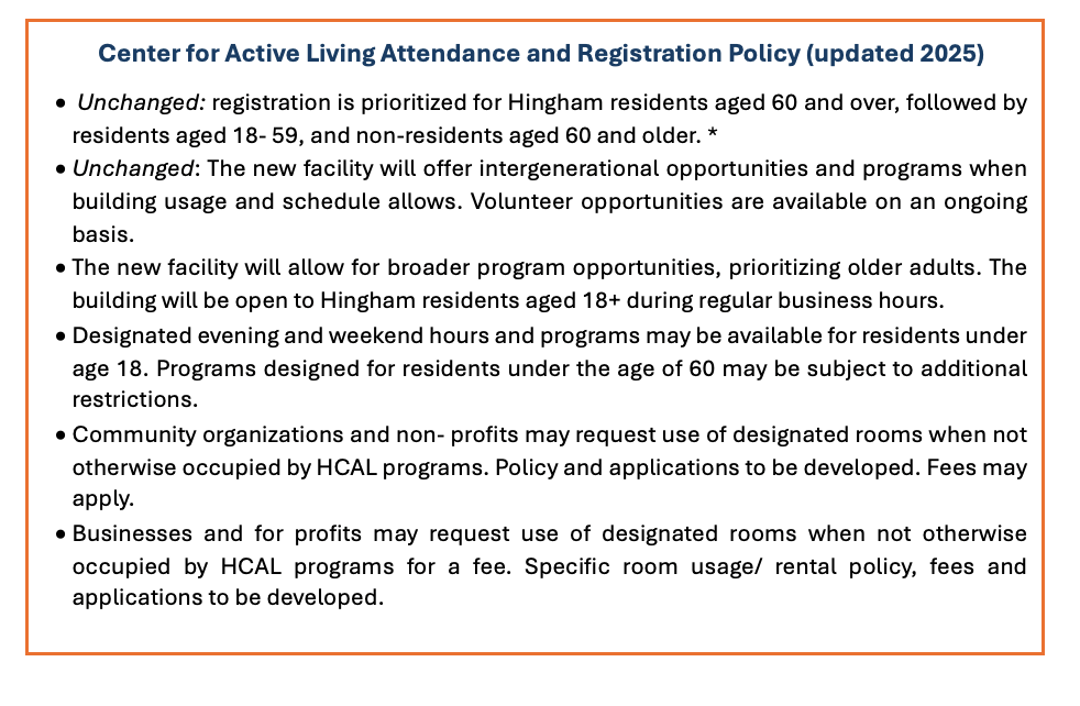
The Center will offer space and features to support additional intergenerational uses. See the unchanged policy below for adults over age 18 and intergenerational opportunities. Programs and hours for residents under age 18, and alternate uses, will be explored in the future, informed by utilization and scheduling patterns. See the policy below.
While growth in Intergenerational engagement is a celebrated vision, the Center is designed in response to Hingham’s large and growing population of older adults. Today, close to 1 in 3 residents are over age 60 (7,904 residents); and 46% of Hingham residents (11,400) are over age 50.
When considering the large size of the older population, it is important to recognize the features and scale of the Center that were designed for accessibility; essential health services; and wellness promoting programming. The functional and circulation spaces are scaled at a higher square footage than minimum building code to be accessible, supportive, and inclusive for diverse needs (e.g. wider hallways with seating, and increased clearances in restrooms and programming spaces.)
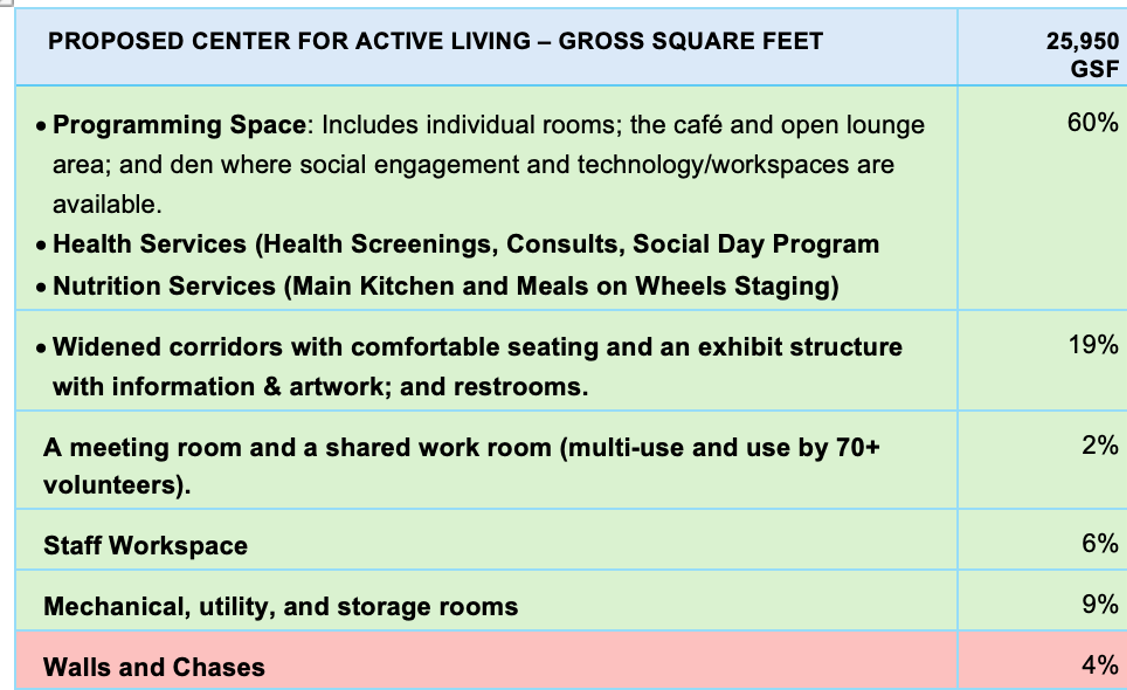
While some have described the building as large, the scale becomes more relatable when the essential elements of the building are considered. Of the building’s 25,950 gross square feet, close to 96% is dedicated to functional spaces. The remaining GSF is non-usable space (e.g. walls and chases).
For context, a breakdown of the space is included below. The individual spaces demonstrate how the design responds to diverse needs, interests, and health status among generations of older residents. The capacity of each programming room (e.g. fitness room (20); arts rooms (24)) demonstrates why enrollment in programs will be prioritized for Hingham residents age 60 and over; followed by intergenerational use.
A Community Center model was discussed early in the planning process. The size of Hingham’s overall population would have called for a larger, more expensive building, as demonstrated during the Building Committee’s peer comparison analysis. As well, it was not a goal for the Recreation Department to be re-located from Town Hall (where summer camps are based; and there are indoor fitness spaces, outdoor fields, courts, a walking track, a playground, and a gymnasium).
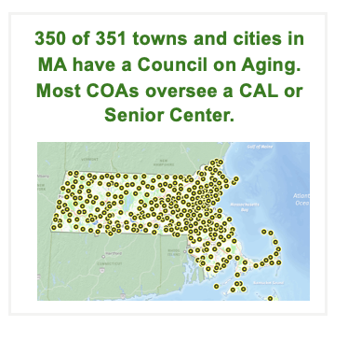
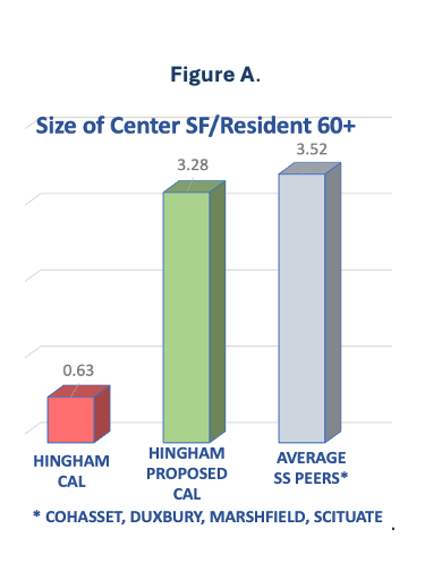
Each community has unique features that inform the design of their Centers (size of overall and age 60+ populations, as well as the overall infrastructure and programming resources in the community.) The design in Hingham offers intergenerational use while reflecting the goal of maintaining reasonable scale and consideration of other programming features in the community, including the recreation department, community pool, and library. The proposed CAL (reduced in size (~10%) and cost (~25%) since Town Meeting 2025) will be proportionately smaller than Senior Centers included in the South Shore peer community analysis. See figure A.
The Town of Hingham has supported and invested in the CAL project over many years. Please support Article 12 to ensure that an adequate Center exists for older residents, future older residents, caregivers, and the community experiences of aging —for the next 50+ years in Hingham’s history.