
April 24, 2026 submitted by Mary Anne Jackson, Hingham Resident, Past co-chair, Back River Watershed Assoc., Retired teacher
Deep in the forest of the southern end of Hingham’s Bare Cove Park there is a fresh water ecosystem that is one of only three sources of fresh water for the Back River estuary, a mix of fresh and salt water, that supports a large variety of fish and shellfish. Today this ecosystem is at risk of being irrevocably damaged, the Back River estuary altered, and its marine life threatened.
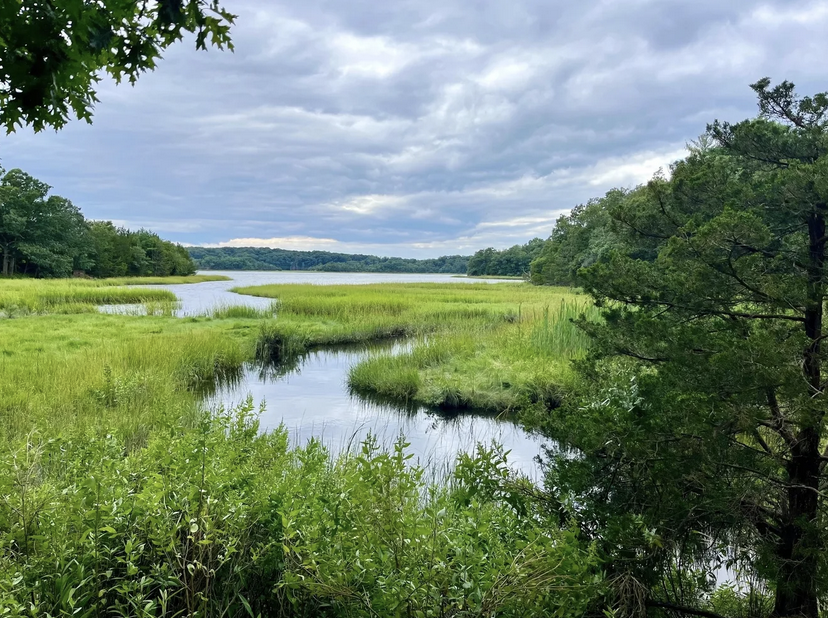
This freshwater ecosystem consists of surface water from Conservatory Park and Baker’s Hill, wetlands along Beal St., intermittent streams, Tucker’s Swamp, and ground water from the adjacent forest, all draining into Hockley Run, a perennial stream that flows into the Back River at Beals’ Cove. There Hockley Run’s fresh water mixes with the salt water of the tidal Back River to create its estuary. “Estuaries, where fresh and salt water mix, are among the most productive ecosystems in the world and are critical to the survival of marine species. [The Ecology of the Back River, Eichner, White & Howes, UMassDartmouth School for Marine Science, 2017.]
History (and archeologists) tell us that the Back River, formed in the last Ice Age, provided prehistoric and indigenous peoples, settlers, colonists and farmers with seafood over many thousands of years. You can still see old oyster reefs in the river at low tide and Indian shellfish middens along the river’s banks. You can also walk along Gt. Esker, at 90’ the highest esker (a glacial deposit) on the East Coast.
In the 19th century, when the Industrial Revolution began to dam rivers for power and use for waste disposal, rivers were blocked and polluted; river herring populations plummeted because the fish could no longer reach their spawning grounds. Oysters died, clam beds were closed, smelt disappeared.
Then, in 1971, Dr. Mary Sears, a pioneering oceanographer of the Woods Hole Oceanographic Institute, found Weymouth educator, Mary Toomey, at her summer science center on the Back River, and asked for her help. Mary Sears foresaw worldwide famines in the future and knew that the Back River’s river herring, a keystone species at the bottom of the marine food chain, could become a major food resource for the fisheries of Boston Harbor and the Gulf of Maine. Mary T. said “yes,” and every Friday afternoon, for the next year, she drove to Woods Hole where Dr. Sears taught her the science of rivers, oceans and fisheries.
For the next 30 years, the two Marys, the scientist and the activist, worked together to increase the Back River’s river herring population. They were successful in establishing nine state and local parks along the river to protect the watershed from development, in persuading the state to build five fish ladders so the river herring could reach their spawning grounds in Whitman’s Pond, and in cleaning up the worst of the pollution. The river herring population increased to a high of about 500,000 and the Back River was considered a major Massachusetts herring run. “We are all stewards of these natural resources and each one of us should take an interest in saving them.” [Two Women and a River, Toomey, 2022.]
Mary Sears, recipient of many scientific honors and awards, had a Navy ship named for her. Mary Toomey, widely recognized for her environmental work, was awarded the prestigious Gulf of Maine Visionary Award.
Today, every spring one of nature’s miracles occurs on the Back River. Hundreds of thousands of river herring, also known as alewives, an anadromous fish that lives in both salt and fresh water, migrate from the Atlantic Ocean, where they live, swim through Boston Harbor and Hingham Bay to the Back River, then up five fish ladders to spawn in freshwater Whitman’s Pond, the place where they were born. The YOY (Young of the Year) swim back to the river’s estuary where they grow until they are ready to return to the ocean. You can see this herring run in action right now in Weymouth’s Jackson Square.
“Everything eats alewives: striped bass, bluefish, brown trout, lake trout, landlocked salmon, smallmouth bass, largemouth bass, pickerel, pike, white and yellow perch, seabirds, bald eagle, osprey, great blue heron, gulls, terns cormorant, seals, whales, otter, mink, fox, raccoon, skunk, weasel, fisher and turtles.” [Maine Dept. of Marine Resources]
Sadly, today, however, the health of the Back River, its tidal flats and salt marshes is once more at risk. Climate change, droughts, shrinking wetlands, increased river pollution, and land development along the edges of Bare Cove Park, are compromising this fresh water ecosystem that is so vital to the health the Back River estuary.
The Great Blue Heron roosting area in Tucker’s Swamp is long gone, the song birds that used to wake me on spring mornings sing no more, invasive Japanese Knotweed is choking out native vegetation, and the soft shell clam beds at the north end of Bare Cove Park are closed. The headwaters of Tucker’s Swamp on Bare Cove Park Drive, that once contained wellheads that supplied water for the Navy ammo depot, is now just barely visible as a shallow pool. Hockley Run runs dry (does not reach the river) some summers. River herring populations are declining up and down the East Coast because of loss of habitat and bycatch at sea.
Consider this too: The Pew Charitable Trust reported last fall that, for the first time in human history, mankind is taking more water out of our water cycle, a finite closed system of evaporation and precipitation, than is going into it.
And now, on top of these choppy seas, comes a perfect storm: Three large development projects are being proposed for this already highly stressed area of Bare Cove Park. The 8.6 acre Housing Authority senior apartments site at 100 Beal St., the 5.38 CAL acre site off Bare Cove Park Dr. and the .635 acre pickleball courts site at 25 Bare Cove Park Dr. all have their individual environmental problems.
But, even if all wetlands regulations are carefully followed, these three developments will still circle Tucker’s Swamp and Hockley Run, deprive them of water, squeeze, shrink, and irreversibly damage this sensitive ecosystem. The three developments, in an already fragile area, could be the death knell of this ancient fresh water ecosystem, alter the salinity of the estuary and reduce the river herring population and the offshore fisheries populations.
Some people say of the CAL project, “But it’s only five acres!” In nature, the whole is always greater than the sum of it parts. Fragmentation destroys. Everything is connected. MassAudubon estimates that for every acre of development, over four acres of surrounding land are also adversely affected. Five acres becomes part of 14.6 acres when considered as part of a whole. Multiply that by four. Death by a thousand cuts.
Hingham certainly needs a bigger better senior center, but not at this site with its huge environmental and economic costs. Clear cutting five acres of forest, demolishing a contaminated ammo depot storage building and remediating the soil for $6-8 million dollars before even beginning to build does not make economic sense. Destroying a forest that was deliberately included in its Area of Critical Environmental Concern designation because it is a protective barrier to the nearby wetlands as well as a critical source of water is an environmental “no no.” Paving over five acres of forested land that today sends surface and ground water into the adjacent ecosystem, will adversely, irreparably and permanently, affect the Back River’s estuary, its river herring population, the Boston Harbor/Gulf of Maine fishing industry, and, ultimately, the supply of the seafood that we eat!
Please vote NO on Article 12—NO CAL on this forested site. Vote NO to save water, to save the river herring, and to save our seafood supply. Vote NO to honor the memory of the two Marys and the many people who have worked so hard for so many years to save this river and its watershed.
This is great information. I didn’t know the history of the land. I agree that this is not the place for a senior center. It seems like it would be years of construction which may affect all the outdoor sports for young athletes.
Ty I appreciate this caveat and I am voting no!
Many thanks to Mary Anne for this incredibly well researched article about the Back River estuary. It is so informative! Everyone should read it before voting.
Mary Ann Carnes
Thank you for explaining the broader reaching, longer lasting, devastation to Bare Cove and, eventually, to the wild life and human human life of our community and to those beyond the Hingham political boundaries. No amount of mitigation and denial can adequately address the long term impact of the three proposed projects. Even more than the onerous costs of these ill-conceived proposals, the quality of life for future generations is at stake. I’ll be voting “No.”
Thank you for this article. If we don’t protect special parks like bare cove , we will lose our special places that help us to be in nature and revitalize our body and brain in this world of automation we are now living in. 💕