

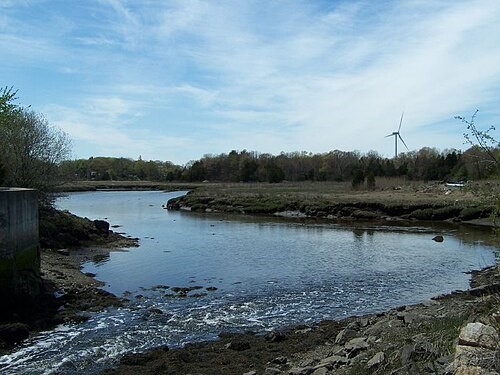
The Weir River from Hull looking East
September 3, 2026 Submitted By Hingham Resident John Borger
In Part 3, we reviewed the state and federal limits on PFAS in our water. Let’s backtrack a bit and do a level set: PFAS “forever chemicals” in Hingham? We’ve never had a Dupont plant here. Why does the WRWS have a PFAS problem? How did PFAS get here?
While Hingham does not have a history of industrial firms depositing PFAS residue, we are still vulnerable to the “global reservoir” of these substances. Because PFAS does not break down, the millions of tons emitted by industry over the last 50 years are still trapped in the global atmospheric water cycle. Even without new factory emissions, previously generated PFAS is constantly evaporating out of contaminated ocean spray and landfill vapors, entering the clouds and falling back down in the rain.
Around 27% of WRWS water comes from Accord Pond and Fulling Mill Pond. While rain deposits PFAS into these surface water sources, most PFAS chemicals in our soil and water actually come from local sources (us) – from ongoing consumer disposal of hundreds of different PFAS-laced products, from septic systems with leaching fields that deposit traces from household sources like laundry, and from lawn care product run-off. Remember – PFAS lasts forever.
PFAS Compounds Hingham’s Tragedy of the Commons
In prior pieces, I referred to water shortages due to sudden, massive drawdowns of our groundwater from the minority who irrigate as Hingham’s tragedy of the commons. The problem is bigger than suddenly diminished supply, the risk of low hydrant pressure and exasperating summer-long outdoor water use bans. These recurring drawdowns significantly degrade our water quality because they force even more PFAS chemicals to leach out of the soil sediments into our aquifer at an accelerated rate, through a dynamic hydrologists call “pumping-induced plume migration.”
To understand why this happens, we must first understand our aquifer and how our public wells work.
The Structure of Our Aquifer
The WRWS watershed is categorized as an “unconfined, sand-and-gravel glacial aquifer.” It is termed “unconfined” because it has no protective, solid clay “roof” and is thus more vulnerable to pump-induced seepage from the upper levels. Our watershed has three distinct vertical layers:
- The “unsaturated zone”: This is the soil layer between surface vegetation and the water table. The interstitial spaces in the soil are filled with mostly air and a lesser amount of water. Various PFAS compounds lay static here pending heavy rain or lawn watering, when gravity pushes water and PFAS through the soil into the next layer…
- …the water table, or “the saturated zone”: This is where the soil with mostly air in the spaces between its grains (think dry sand) gradually gives way to soil with mostly water between the grains (think wet sand). The water feeding this level is constantly in slow motion, seeping horizontally from high to low pressure areas through the “pores” of the soil anywhere from a few inches to a few feet per day. PFAS in the soil above leaches into the water table, and thence into
- …the deep aquifer: This level was formed when retreating glaciers in some areas left dense, compressed silt and clay layers which act as natural underground umbrellas, partially shielding deeper water-saturated layers from raw surface runoff. The aquifer is not an underground lake; it’s more like a sopping wet sponge with big drips. The water saturating the deep aquifer is naturally filtered; it is clean and ordinarily has relatively low PFAS levels. This is the source from which the WRWS wells pull water, using pumps exerting powerful suction to extract water from the aquifer “sponge” surrounding the wells.
How Our Water Shortages Become Both a Quantity and a Quality Problem
A sudden drawdown necessitated by irrigation creates a “cone of depression”, which disrupts the normal hydraulic behavior of our watershed’s layers. The intense mechanical suction generated by a heavily pumped municipal well can draw shallow, contaminated water from the saturated zone past the mid-level layers of clay into the deep aquifer, where it is then pumped into the wells.
How Do the Wells Function?
Most of us have the untutored impression that a municipal well is a deep hole with walls (like an old wishing well) that takes water from a pool at the bottom. This simplistic picture impedes our understanding of the PFAS problem. The 11 WRWS wells are highly engineered, multi-layered filtration structures known as “gravel-packed wells,” which extend from 40 to 100 feet deep in total. The upper well, surrounded by the shallow surface soil, extends 60% to 70% of total depth and consists of a solid steel outer casing, which does not allow the “dirty” water at this level in. The attached lower portion of the well (30% to 40% of total depth) begins at the aquifer level and consists of a “tube” called a well screen, formed by many layers of overlapping steel mesh which create sediment-blocking microscopic “slots”. This mesh screen is surrounded on the outside by an engineered layer of clean quartz sand and gravel. Rather than sucking like a straw from the bottom, which is sealed, the submerged, centrifugal well pumps create a massive pressure drop which forces the relatively clean water from the surrounding aquifer “sponge” to flow horizontally through the fine sand/gravel filter, then through the sediment-blocking micro-slots, into the well and up to the surface.
The Contamination Caused by Sudden Seasonal Drawdowns
Sudden episodes of sustained, aggressive pumping create a temporary, low pressure, “cone of depression”, causing the water table to drop by several feet during a heavy summer pumping week.
This intense downward suction alters the natural local hydrology, generating enough physical force to pull decades of accumulated PFAS from the shallow level sand grains. The aggressive pumping acts like an underground vacuum, dragging a concentrated plume of once-static contaminants (including PFAS) down past the natural filtration barriers into the well intake zone. The well screening is not able to stop PFAS; the only way to deal with it once it has been drawn into the water is to remove it with expensive, advanced filtration methods that WRWS will have to introduce into its water treatment process. (Refer back to Part 3.)
In our tragedy of the commons, the massive seasonal drawdowns caused by the few who irrigate (and consume 35% of the system’s water) lead to water rationing for everyone. The tragedy compounds, because pumping to try to meet spiking demand degrades everyone’s water quality by causing once-static PFAS to leach into the aquifer, from whence it flows into our taps, and into our bodies.
OK, so irrigation-induced drawdowns make the PFAS problem worse. By how much?
A natural system of this variability and complexity defies precise measurements. But when researchers testing in controlled settings have tracked the vertical movement of PFAS from topsoil down into unconfined aquifers like ours during episodes of hydraulic stress, the PFAS numbers spike dramatically by an order of magnitude, which in hydrology means a 10-fold increase. When a WRWS well is pumped aggressively enough to alter the hydrology of the local water table, the sudden massive draw can cause PFAS levels in the intake zone to transform from an acceptable baseline of 1 or 2 PPT to an immediate spike significantly over regulatory limits. This is how our summer water shortages feed into our looming regulatory problem.
In Summary…
All the evidence lines up in one direction: it is imperative that we stop the massive, irrigation-driven drawdowns of this precious, shared resource. The physical, economic and fiscal health of the town depends on it. The one universally recommended measure to limit demand that the WRWS Commissioners have not yet tried is to apply basic economics through steeply tiered pricing.
The Commissioners are caught in a vise formed by the inexorable pressures of opposing forces: 1) the unquenchable thirst of the irrigators versus MassDEP limits on the volume of water they can extract from the watershed; 2) drought-induced reductions in water availability versus aggressive pumping to try to satisfy demand and maintain water pressure, especially for hydrants; and 3) increased, pump-induced PFAS infiltration even as the EPA’s imminent PFAS mandate looms, with onerous sanctions for non-compliance.
Rate payers already unhappy about inflation and a probable Proposition 2 1/2 override in Hingham will likely bridle at funding expensive local filtration to comply with regulatory standards we might conceivably meet if we sharply curtailed spiking seasonal demand. They will understandably want to know whether every feasible measure has been tried to curtail that demand, especially when they realize that 35% of the precious water they will be paying many millions more to filter will end up being dumped onto lawns – at bargain rates. It is not unthinkable that some may press for maximum usage limits based on household size, with high “demand” charges levied on excess usage, similar to how HMLP prices electricity during peak demand.
Our tragedy of the commons is destined to intrude into Town politics. The WRWS Commissioners have a choice: they can pursue common-sense solutions based on simple economics, or they can stay with the status quo and preside over regulatory peril and escalating ratepayer unhappiness.
Next up in Hingham H2O – Part 5 – Why state oversight means the WRWS Commissioners cannot simply “pump more water.

John Borger has lived in Hingham for 37 years and has been active in the Town’s fight against climate change and its quest for sustainability.