

November 10, 2026 By Carol Britton Meyer
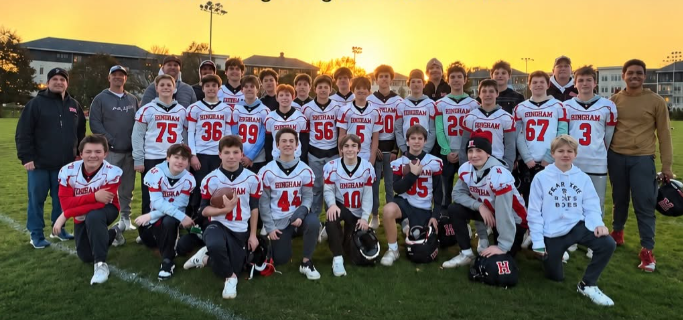
Hingham Youth Football & Cheer asked the School Committee Monday night to consider sponsoring an application to the Planning Board to amend its 2015 amplified sound guidelines for the Hingham High School athletic field complex.
HYF is seeking permission for supervised play-by-play announcing and limited, age-appropriate music before kickoff, during timeouts, between quarters, and “during other natural breaks in play” at all approved HYF home football games, including approved postseason games. The proposed changes would take effect with the 2027 season and continue thereafter, “subject to clear operating conditions.”
Committee member Tim Dempsey observed that if the change is approved, “it would give a private organization more of a right to amplified sound than is [currently] granted to Hingham High athletes” using the fields.
Play-by-play announcing
For purposes of the proposal, the letter states, “‘play-by-play announcing’ would include concise descriptions of completed plays, identification of participating players, and relevant game information, including the score, down, and distance. Announcers would recognize both teams respectfully and keep comments informative and positive.”
Currently, Hingham Youth Football & Cheer is permitted to use the amplified sound system for player introductions, the National Anthem, and halftime in conjunction with a choreographed cheerleading or dance routine. Play-by-play announcing and music during other portions of HYF games are not allowed.
Any changes would require Planning Board approval through the required review process.
The goal, according to a four-page letter signed by HYF & Cheer Chief Operating Officer Melissa Sadler, is to provide a “positive, engaging experience for young athletes, cheerleaders, and families while respecting the surrounding residential neighborhood through appropriate sound limits and clear accountability.”
Existing guidelines and restrictions detailed
The letter outlines the existing guidelines and restrictions, the requested changes, the justification for the proposal, potential neighborhood impacts and noise mitigation measures, and compliance and accountability provisions.
Explaining the reasons behind the request, the letter states, in part:
“Play-by-play announcing helps spectators follow the action and recognizes participating children’s efforts. Brief explanations of completed plays make games more accessible to family members and younger spectators unfamiliar with football’s rules.
“Appropriate announcing reinforces sportsmanship by recognizing effort, teamwork, and accomplishments on both teams. Limited music during breaks adds energy and creates a welcoming atmosphere for players, cheerleaders, families, and visiting teams.”
Building community spirit
The letter also states that updating the guidelines would modernize HYF’s game-day experience.
“Other towns’ youth football programs are able to announce games and play music, and we would like Hingham’s children and families to enjoy a comparable experience. These familiar elements of youth sports build community spirit” and make participation more memorable.
HYF & Cheer welcomes the opportunity “to work with the School Committee, school administration, Planning Board, and neighboring residents to establish clear, workable conditions that support our youth programs and respect the surrounding community,” Sadler concluded.
Neighbors weigh in
A resident of the nearby Meadows development expressed concern about the possibility of adding play-by-play amplified announcements.
“We haven’t had that before, and we’re concerned about the sound levels,” he said, also speaking on behalf of his wife.
A Downing Street resident who was involved with an earlier amplified sound agreement said neighbors “believe the entire complex is a gift to the town, and we’re not anti-field, but . . . this would be a monumental change that needs to be given a lot of thought, with input from abutters.”
Another Meadows resident, Liza O’Reilly, who was on the School Committee when the 2015 revision to the 2013 agreement was made, said that since moving to the neighborhood, she has experienced a number of loud games involving use of the PA system.
“I was in my house with the doors and windows shut and the sound was so loud that it [interfered with] my television,” she said.
‘This would be a significant change’
O’Reilly recalled being home during a game on Oct. 10 and hearing “play-by-play commentary and a song, then noise, another song and then more noise, and I asked myself, What is going on here? When I saw this proposal I thought, That wasn’t even supposed to be happening – that’s what this proposal is [asking for].”
O’Reilly suggested conducting a 10-year look-back at amplified sound use over that period and considering whether the speakers could be limited to the press box side.
“If we can control the sound better, maybe it will be okay,” she said, while expressing continued reservations. “This would be a significant change.”
After reviewing the letter and listening to feedback from abutters, committee members agreed that the policy subcommittee should review the request and report back to the full School Committee.
Could the sound system be modified?
Committee member Kerry Ni wondered whether the sound system could be modified to lessen the impact on neighbors and who would be responsible for enforcing the rules if the request moves forward.
This is something “we could set the parameters around if an application is submitted,” Chair Jen Benham said.
The committee also agreed on the importance of holding a public hearing at an upcoming meeting, following the policy subcommittee’s review, and making sure abutters are notified so they have an opportunity to share their thoughts and concerns.
To read the letter in full, click here.
To read the 2015 amplified sound guidelines, click here.