May 28, 2026 By Carol Britton Meyer (With Photos Provided By Ken Corson – Hingham Harbormaster)
On Wednesday, May 20, Harbormaster Kenneth Corson responded immediately to a distress call received at 5:42 p.m. regarding an individual in the water. Here he shares the details of that rescue – who else was involved, and what it means to him to help save a life – with the Hingham Anchor and offers tips for a safe boating season.
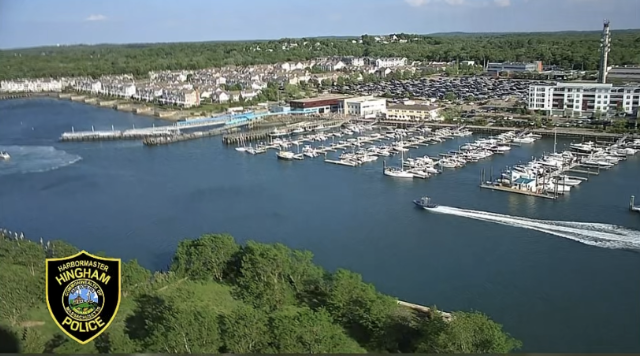
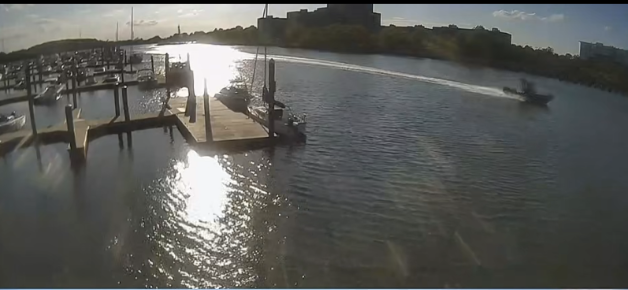
“As Hingham harbormaster, I immediately deployed. Because I was operating solo and a fast response was absolutely paramount, I chose to deploy on Hingham Marine 2, a 25-foot SAFE Boat powered by twin Suzuki 250s,” recalled. “This specific vessel allowed me to transit to the scene quickly while throwing a minimal wake, minimizing disruption or danger to other vessels and persons in the area.”
Corson was on the scene within 10 minutes, locating the incident – which involved a vessel with four occupants, two of whom unexpectedly fell overboard — in Hingham waters just north of Bumpkin Island.
The female party was able to swim back to the vessel and safely climb back on board with the assistance of the two remaining passengers.
“The male party was unable to reach the boat and was actively struggling to stay afloat due to limited swimming ability,” Corson recalled.
Shortly after his arrival on the scene, the U.S. Coast Guard and the Boston Harbormaster arrived to assist.
“The male party was in imminent danger, and it ultimately took four of us working in close coordination to fully extract him from the water and bring him aboard Hingham Marine 2,” Corson said. “Based on my immediate assessment, it appeared that the individuals on board had limited boating knowledge and experience, which compounded the severity of the situation.”
In marine emergencies, the primary goal is always to stabilize individuals and swiftly transport them to shore for professional medical care, he explained. “Furthermore, transferring individuals to land is important when dealing with agitated or traumatized parties. A boat is a highly confined, unstable environment where heightened emotions can quickly compromise safety. Bringing everyone to shore provides the space and security necessary for fire department personnel to properly evaluate injuries and treat, while allowing shoreside police units to assist freeing the harbormaster boat to return to the scene.”
Immediately after transferring the male party to shoreside medical personnel, the rescue team returned directly to the scene near Bumpkin Island. “Initial reports were chaotic and conflicted, suggesting there might be two additional missing individuals,” according to Corson. “We conducted a secondary search and confirmed that no other persons were in the water. Fortunately, all occupants were quickly accounted for, and we verified that everyone was safe.”
When asked what his thoughts were while responding to the scene, Corson had this to say:
“When a call like this comes in, your adrenaline spikes, but your training instantly takes over. Operating solo on a fast response means you have to be entirely locked in. As I pushed Marine 2 toward Bumpkin Island, I was monitoring my wake while racing through a mental checklist: evaluating radio reports, the tide, and formulating rescue strategies. In a near-drowning scenario, seconds truly mean the difference between a rescue and a recovery.”
The harbormaster team is trained to respond to emergencies such as this one. “Our team trains to handle the unpredictable nature of marine emergencies – from vessel operations, navigation, and search and rescue to firefighting and first aid. We also focus heavily on inter-agency coordination,” he said.
This incident “perfectly highlighted the value of that training – when the Coast Guard and Boston harbormaster arrived, we operated as a single, seamless unit. It took all four of us to get him out of the water. That level of teamwork is only possible through shared training and mutual respect,” Corson said.
Being in a situation such as the May 20 incident is to Corson “a profound reminder of why we arrive at work every day. The ocean is beautiful, but it is entirely unforgiving. To arrive at a scene, look into the eyes of someone who is losing their struggle against the water, and pull them to safety is an incredibly humbling experience. Knowing that a family member returns home whole because of our quick, coordinated response is the greatest reward there is. It reinforces our shared commitment to keeping our harbor safe.”
Harbormaster’s tips for a safe boating season
To prevent situations like this from happening in the future, Corson urges all boaters to follow these essential summer safety tips – especially in light of updated state regulations:
- Get certified under the Hanson-Milone Act, which mandates safety education for motorized vessel operators.
– Anyone born after January 1, 1989, is now required to have successfully completed an approved boating safety course and carry a valid boater safety certificate on board.
– Anyone born on or before January 1, 1989, has until April 1, 2028, to obtain their certification. “This incident proves that basic boating knowledge saves lives – don’t wait to take your course,” Corson said.
- Wear Your Life Jacket (PFD): Emergencies happen in the blink of an eye. A life jacket only works if you are wearing it before you fall into the water.
- Assign a ‘lookout’: Always have someone on board keeping an eye on passengers, especially when the boat is in motion or navigating choppy waters.
- Understand local waters: Familiarize yourself with Hingham’s tides, currents, and shallow areas before heading out.
- Dress for the water, not the air: Early season water temperatures remain dangerously cold, which can cause immediate shock and exhaustion if you fall in.