

October 20, 2026 By Carol Britton Meyer
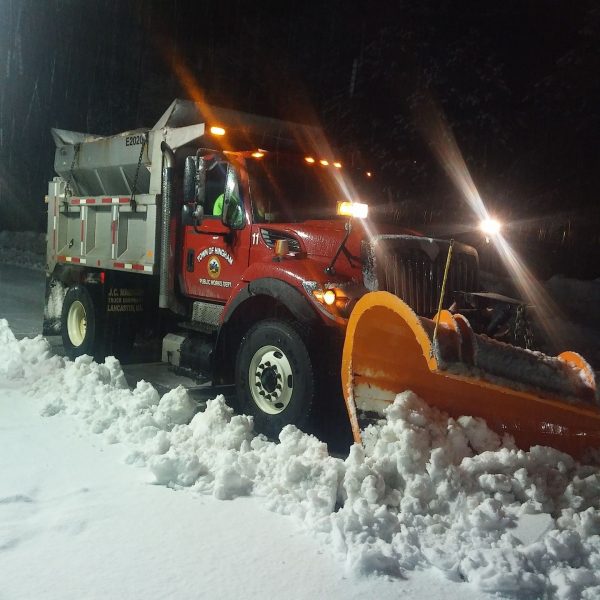
The select board agreed unanimously at its well-attended meeting Tuesday night to delay implementation of a new Department of Public Works private roads/ways plowing policy they recently approved to start this year following a public outcry from some of the residents it would affect.
Of the 211 private ways in Hingham, 139 have never been plowed by the town but by private contractors for various reasons, Chair Liz Klein noted.
“On occasion the planning board may approve that a road remain private – at a lower cost to the developer [because this means certain standards do not need to be met] but saddles the residents with the maintenance, [including plowing],” she said.
Residents living on private roads must meet minimum 10 to 12-foot width and also turnaround standards for the safety of residents and DPW staff in order to continue to be plowed or hire a private contractor in cooperation with their neighbors at a shared expense. In some cases, they can sign a waiver freeing the DPW from liability for any property damage.
‘Disappointed’ at new policy
The current policy will remain in effect until Nov. 1, 2027, which will give residents – a number of whom said they were “disappointed” or “shell-shocked” when they received the letter from the DPW outlining the new policy with no prior notice and with winter fast approaching — time to talk with DPW Superintendent Ashley Broyer about their particular circumstances and either bring their roads into conformance with the new policy by next November, sign a waiver, or hire a private contractor to do the plowing starting next year if they are available. Each private road or way will be considered on a case-by-case basis.
A number of the private roads in town don’t meet the standards that are in place to protect the safety of the neighbors and DPW staff, and some DPW and contractors’ equipment has been damaged. Broyer inspected the private ways earlier and determined which ones met the standards and which did not and notified the affected residents.
“This new policy makes for safer roads, and contractors who plow them will be more willing to do so,” Broyer said.
Residents caught by surprise
Because the change was not well-received and caught homeowners by surprise, the board placed the issue on their Oct. 20 agenda for further discussion following a back and forth among concerned homeowners and board members and DPW Supt. Ashley Broyer.
Chair Liz Klein then sent a letter to affected residents notifying them of this week’s meeting and her willingness to have a public discussion around the issue.
Broyer has already visited dozens of private ways/roads in response to residents reaching out to her. “I’m happy to work with homeowners to help them make their private ways compliant with the minimum standards,” she said – which might be as simple as cutting down a bush and paving the area to allow more room for plows to maneuver.
With respect to safety, Broyer said that the DPW is “in constant communication with emergency personnel, and we know where the police and fire departments are headed. We hear it on the radio and head that way regardless of whether it’s a private way or not.”
‘Hiring a private plower is quite an expense’
One resident expressed concern that “hiring a private plower is quite an expense. We moved to a private road because it had been plowed for decades. The added cost of this service in addition to rising taxes could push people out [of town].”
Donald Campbell, a 60-year resident of Quincy Avenue with his wife, spoke out strongly against the new policy. “In the 60 winters we’ve been here, we’ve depended on the town to clear our street, with no fear that they wouldn’t be there to plow us out,” he said. “Every year we [and our neighbors sign a [document] that we will not hold the town responsible for any property damage, and I know of no occasion when there has been any.”
Campbell went on to say, “I’m so disappointed in you people for handling this the way you did – sneaking up on us with hardly any time to react. [The new policy] would have gone through, and we’d all be left holding the bag at the beginning of winter [this year] if people hadn’t spoken up.” Applause followed his comments.
Elizabeth Lane resident Patrick Leahy said he was “incensed” when he read the letter from the DPW announcing the new policy. “It wasn’t thought out. It was kind of back door.”
‘Shell-shocked’
Bayview Avenue resident Janet Powell said the DPW has been plowing her family’s home for more than 60 years and that she was “shell-shocked” when she read the letter.
She further noted that one of her concerns is whether private contractors are equipped to do sanding and salting in addition to plowing as the DPW crews do.
“Our street can be like an ice rink,” she said. “Without this moratorium [on the new policy], it would have been a disaster if we had to hire a private contractor at the last minute,” she said.
William Reardon of Steamboat Lane explained that it would be difficult “to respond to the width issue because of the way the lane was laid out hundreds of years ago.”
At the same time, a couple of residents expressed appreciation that the board was considering – and ultimately approved – the one-year delay to give those affected by the policy time to find solutions.
“This has been an extremely helpful meeting,” Hull Street resident Jeremy Parker said. “My concern is a matter of the process by which this policy was reconsidered.”
Broyer noted this is the first change in the past 46 years and that former DPW Supt. Randy Sylvester had brought up the need to change it but didn’t have enough time before he retired.
Parker then asked to be kept informed of the decision points along the way during the next year “so we’re not blind-sided at the last minute.”
‘It’s been a thoughtful process’
In response, Klein said these changes have been in the works for some time and that it’s been a “thoughtful process.”
She went on to note that the board can’t notify individuals regarding meeting agendas, but that they are posted 48 hours ahead of time to give the public ample time to view them and to plan to attend if they wish to. “Nothing is hidden,” Klein said. “They’re all public meetings.”
She encouraged residents with concerns or questions to reach out to the DPW or the board. “It’s starting to get cold out!” she said. “We approved the one-year delay” to work with residents on a solution and for Broyer to make further visits to neighborhoods, along with more recommendations.
“There will be further discussions, and we can take another vote if necessary [down the road],” Klein said.