

February 27, 2025 By The Hingham Unity Council
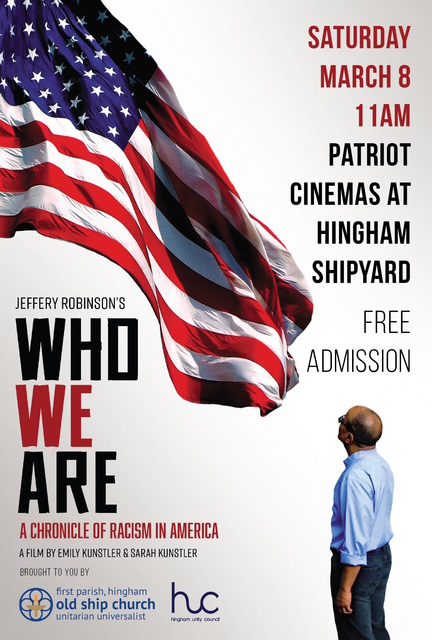
Saturday, March 8 at 11 a.m. at the Hingham Shipyard Theater
Free Admission
The Hingham Unity Council and Old Ship Church are co-sponsoring a viewing of this award winning documentary film on Saturday, March 8. Admission is free. The film features Jeffery Robinson, a graduate of Marquette University and Harvard Law School, and a trial lawyer for over 40 years – as a public defender, in private practice, at the ACLU, and now at The Who We Are Project. In 2011, Robinson began raising his then 13-year-old nephew and, as a Black man raising a Black son, struggled with what to tell his son about racism in America. How, he wondered, did we get here? And when he started looking at our Nation’s history, Robinson was shocked by what he had not known.
In Who We Are: A Chronicle of Racism in American, Robinson is asking all of us to examine who we are, where we come from, and who we want to be. Anchored by Robinson’s 2018 performance at NYC’s historic Town Hall Theater, the film interweaves historical and present-day archival footage, Robinson’s personal story, and observational and interview footage capturing Robinson’s meetings with Black change-makers and eyewitnesses to history. From a hanging tree in Charleston, South Carolina, to a walking tour of the origins of slavery in colonial New York, to the site of a 1947 lynching in rural Alabama, the film brings history to life, exploring the enduring legacy of white supremacy and our collective responsibility to overcome it. Robinson exposes how deeply encoded white supremacy, and the oppression of Black Americans is in our nation's history. Weaving heartbreak, humor, passion, and rage, Robinson shows us how legalized discrimination and state-sanctioned brutality, murder, dispossession, and disenfranchisement continued long after slavery ended, profoundly impeding Black Americans’ ability to create and accumulate wealth as well as to gain access to jobs, housing, education, and health care. His words lay bare an all-but-forgotten past, as well as our shared responsibility to create a better country in our lifetimes.
Emily Kunstler, who directed the film along with Sarah Kunstler, states, “Throughout the making of this film, one of the questions we often get is why are two white women making this film? Our answer is that the history of slavery in the United States is not Black history, it is American history; a history of white supremacy and white complicity as well as a history of Black oppression and resistance. Growing up, Sarah and I were taught that it was our moral responsibility to stand up against racism and fight for justice. This responsibility includes learning and sharing our country’s painful history. This film is a collaborative effort between Black and white Americans to get back our nation’s stolen history, to accept our obligation to learn it and represent it, and to come to terms with it as our shared inheritance. It is also the profile of a man on a quest to share what he has learned and to go beneath that history to the lived experience of Black people whose lives have been shaped by a legacy that our country has largely forgotten. It is a film that meets the historical and cultural moment in which we are living. It asks all of us to examine where we come from, who we are, and who we want to be.”