July 16, 2025 By Carol Britton Meyer
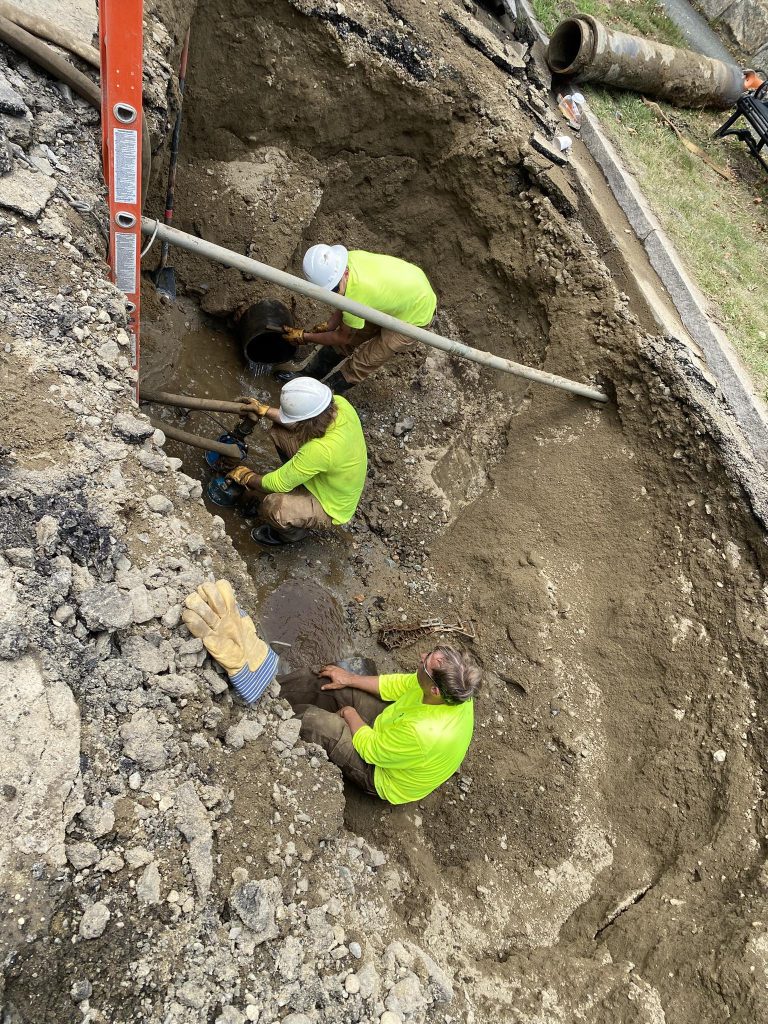
In response to being tasked to work with the Weir River Water System operator, Veolia, and the Hingham town administrator to develop a plan to mitigate the frequency of discolored water, WRWS Managing Director/Superintendent Russell Tierney explained potential causes and future plans for improvements to the Hingham select board — in their role as water commissioners — this week. WRWS serves Hingham, Hull, and part of Cohasset.
Board chair William Ramsey prefaced Tierney’s presentation by saying the commissioners “are as frustrated as you are. While a mitigation plan will be shared tonight, we can’t tell you that there will no longer be water main breaks,” he said. “However, our goal is to do everything we can to make improvements.”
Part of that plan is implementing a water main break tracking and analysis system.
Discolored water is often a result of water main breaks, service leaks, and on occasion, planned system maintenance,” Tierney said. “Ongoing, effective maintenance is key to reducing the extent of discolored water during breaks and leaks.”
Improving monitoring of main break locations
Using GIS, “we will improve our monitoring of main break locations . . . which will allow us to see ‘clusters’ of breaks and pressure abnormalities at a glance and then work with our consultants to prioritize replacement,” Tierney said.
Another improvements will be the institution of a valve inspection and replacement program, which is key to the distribution system, along with a more efficient “unidirectional” flushing program versus conventional flushing.
UDF is a method of cleaning existing water mains using multiple flushing sequences, discharging the water through fire hydrants.
System flushing is also key as well as properly operating gate valves.
Potential water main break causes are changes in temperature or water pressure, thermal expansion, freezing or thawing, ground movement and settling, vibration from construction, and soil erosion/destabilization.
Better communications has another side
Tierney also noted that while WRWS’s improved communications protocol is a good way to get the word out about different issues, “it’s also contributing to the perception that the number of water main breaks has increased over time.”
That’s because while utilization of this far-reaching communications system is providing necessary information to customers immediately, it is also reaching ones who are not in the affected break area — in the past, “they may never have never been aware of these situations,” he noted.
Tierney presented a chart that showed an average of 32.7 annual main breaks prior to the Town of Hingham acquiring the water company in 2014 and an annual post-ownership average of 21.3.
Maintains more than 200 miles of pipeline
That said, “failures in the distribution system, water mains, services, hydrants, and/or gate valves are part of operating a water system,” he said, noting that WRWS maintains more than 200 miles of pipeline, 12,500 service connections, 1,250 fire hydrants, and more than 3,000 gate valves.
“Cities and towns across America are all dealing with water infrastructure issues due to age, material type, and in some areas, weather,” according to Tierney. “The average number of annual water main breaks per 100 miles of pipe is 11-27. In New England, that number is higher as changes in the weather have an impact on our underground assets.”
About 50 percent of WRWS’s water mains are more than 50 years old, with 22 percent between 25 and 50 years old.
Over the past four years, a capital plan water main replacement program has been underway and plans are in the works to construct a one-million-gallon capacity water storage tank on Strawberry Hill in Hull, which will help stabilize the water pressure and provide additional storage capacity for high demand periods.
Projects update
Upcoming proposed projects include replacing 6,000 feet of ductile iron water main in a portion of Main Street and 9,650 linear feet on Route 3A in the Hingham Rotary area as part of the Summer Street project.
Tierney also reported that “our water sources and capacity are in very good shape” while noting that water storage tanks are “not for lawn watering; they are for fire protection.”
WRWS is in the process of revising current water restrictions to match the state’s drought status, which requires communities to comply with its conservation efforts regardless of a town’s current capacity and local conditions.
About one-third of WRWS customers are complying with current water restrictions, which allow hand watering only. “Too many residents are watering every day!” Tierney said.
To maintain a healthy lawn, “you only need 1 to 1.5 inches of water/rain per week — distributed over 2 to 3 days,” he explained, even when there are no watering restrictions. “Watering deeply and less frequently encourages strong root growth, making your lawn more resilient.”
WRWS “has plenty of water, but we can only pull ‘x’ amount of gallons at a time to get it to the [treatment] plant,” Tierney said.
“There’s no need to water your grass every day.”
In another update, Tierney reported that the billing transition from Veolia to Hingham Municipal Lighting Plant — combining electric, water, and Hingham sewer usage into one monthly bill, will begin July 1, 2026 — with combined WRWS/HMLP customer service. More information will be provided as that date approaches.
Water commissioner/select board member Julie Strehle reiterated that “it’s important that we address these issues — especially brown water. We will keep on top of it and work on good communication, transparency, and doing the work that is required to correct the problem, and keeping at it.”
Whatever resources the town can provide “we will give you,” Ramsey said. “We want to see you succeed and improve. That’s the purpose of this meeting.”
The drought status for the Southeast Region has been Level 0-Normal Conditions, and has been since June 10….
As I write this on July 19, 2025, we in Hingham have been subject to a Level II water ban since June 24th. The WRWS recently stated on the Town’s website that fully 1/3 of the system’s daily water allotment is being dumped on lawns between the hours of midnight and 9:00AM. Carol Britton Meyer’s report above includes the following: “About one-third of WRWS customers are complying with current water restrictions, which allow hand watering only. ‘Too many residents are watering every day!’ (WRWS Managing Director/Superintendent) Tierney said.” Well, no wonder water usage is outstripping capacity.
Is anyone else outraged by this? Piggish water scofflaws thumb their noses at our collective responsibility to be good stewards of a precious resource so they can pander to fragile, finnicky grass varietals and flaunt the de reguer, manicured green lawn. Forget New England woodlot aesthetics, residences today have to look like the campus of a multinational corporation. Armored divisions of landscapers with deafening, polluting tools descend weekly to give sloppy old Mother Nature the Tidy Bowl treatment and douse pampered lawns with various herbicides and insecticides.
What does this mean for me? Per my last statement, at a usage level of 12 CCF (hundreds of cubic feet) per quarter, I am using 20% less water than the average residential customer, who uses 15 CCF. My quarterly volume puts me in the lower 50% of usage. (I am probably far below the higher tiers of users.) My rate for that first 12CCF is $3.974/CCF, compared to the commercial rate of $2.935. As a good citizen, I am scrupulously complying with the stipulations of the Level II water ban, which means I cannot even once use my pressure washer to wash my boat prior to launch or spend a half hour washing my fence preparatory to painting. (A pressure washer at 2-4 gallons per minute uses water far more efficiently than a sprinkler or hand-held hose at 10-20 gallons per minute.) While others flout the rules, my modest needs for brief, occasional outdoor water use have to be postponed indefinitely.
Is all of this in any way fair? I don’t think so. I read that higher volume users pay a higher rate, but the empirical evidence clearly indicates that they are not price sensitive, at least not at the rates levied for higher consumption. This entire situation is sometimes referred to as “the tragedy of the commons”. People will abuse a resource held in common until it’s exhausted. I think that comprehensive structural changes are necessary to the Weir River Water System rates and to the provisions of its “enforcement” regime, which is obviously being ignored by the water hogs. Anybody agree? What are we going to do about it? I have some ideas and will be working on this. Meanwhile, please weigh in with your own comments.