


February 23, 2026 by Glenn Mangurian
Eighth in a Series: Learning about the New Center for Active Living Project
If you follow my Opinions for the Anchor, I prefer positive, educational and thought-provoking essays. This Opinion essay discusses the issue of affordability, in general, and more specifically, as it relates to the proposed new Hingham Center for Active Living (HCAL). See the addenda at the bottom of this Opinion for charts supporting my research. To better understand local views on affordability, I spoke with 19 residents—seniors and non-seniors alike. While not a scientific sample, their perspectives were important to hear.
Summary
Common Concerns Regarding Affordability
- Affordability means different things to different people in Hingham—but of those I have spoken to local property taxes are not most residents’ top concern.
- The most common affordability concerns voiced by Hingham residents were healthcare, groceries, home purchase prices and higher education.
- While there are some residents who have voiced environmental concerns, all State and local permit requests have been reviewed and approved.
Financial Management
- Hingham has experienced sustained growth in property values and maintains a strong residential tax base.
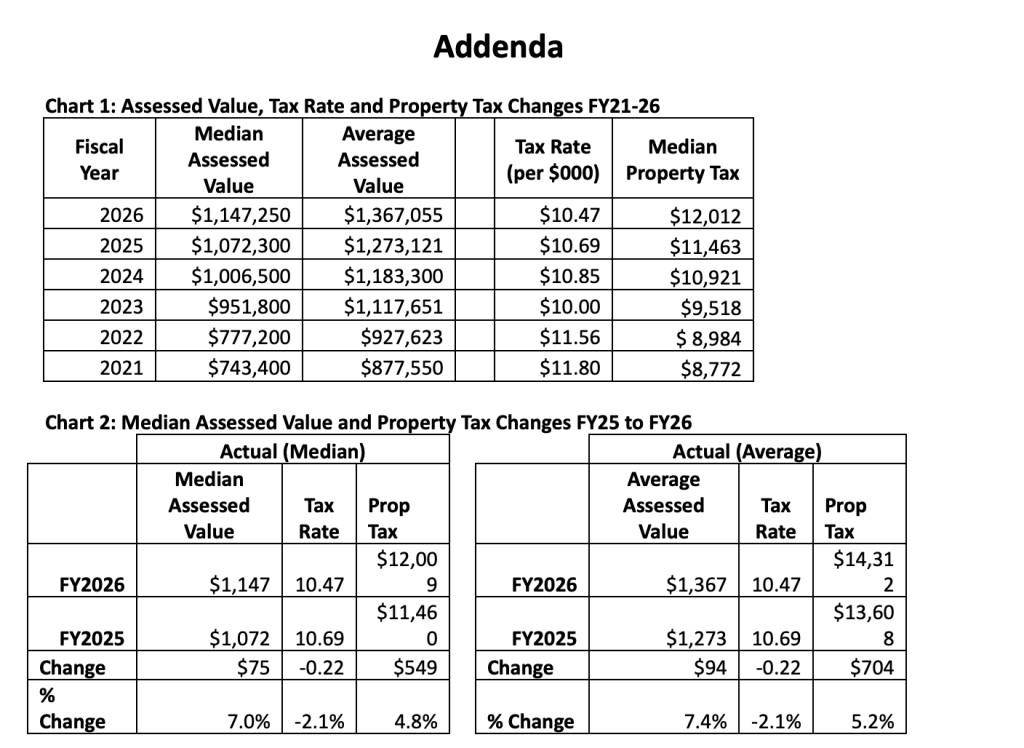
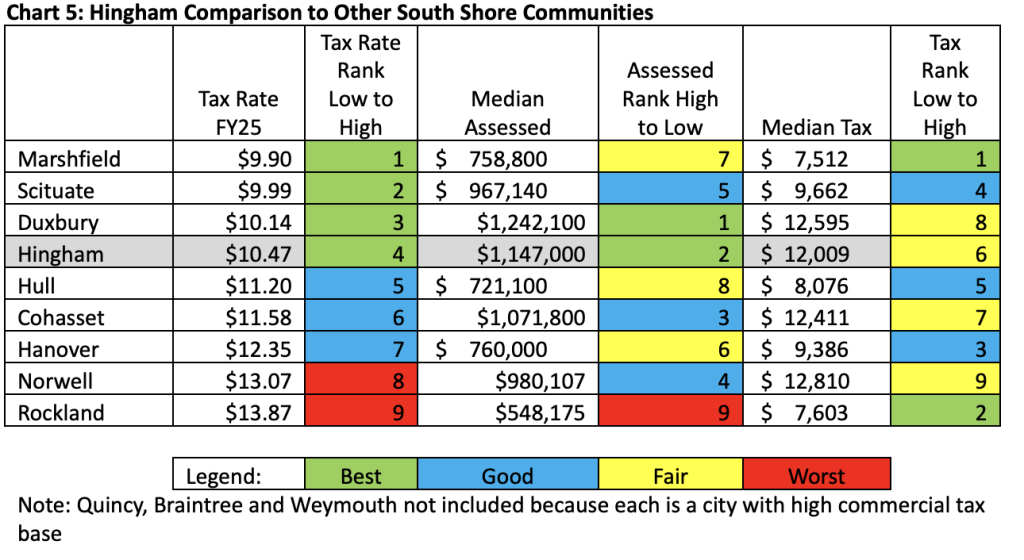
- The median assessed property values have increased 54% since 2021 – near highest on the South Shore with one of the lowest tax rates on the South Shore.
- The FY26 median property tax has increase 4.8% over FY25 median property taxes. This increase includes the borrowing cost for Foster School and the Public Safety Building.
- Hingham again received the highest credit opinion by Moody and S&P. These agencies cited the town’s consistently strong financial position, stable tax base, and disciplined, forward-looking budgeting practices.
Estimate Tax Impact
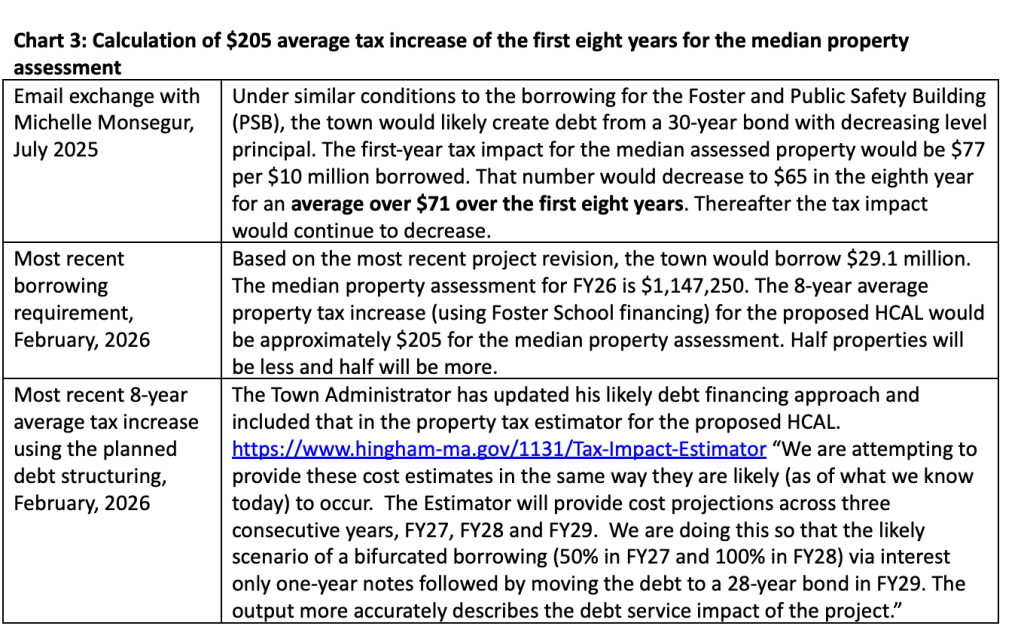
- Based on the Foster and Public Safety Building debt borrowing experience, the median tax bill would increase an average of $205 over the first eight years.
- When explaining the $205 average at neighborhood coffees, attendees commented that the increase was a good investment for a 50-year senior facility.
- The Town Administrator reports that the likely scenario will be a bifurcated borrowing (50% in FY27 and 100% in FY28) via interest only one-year notes followed by moving the debt to a 28- year bond in FY29.
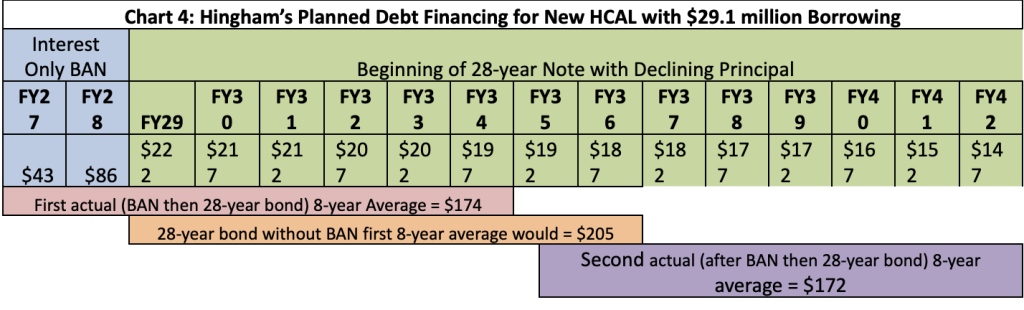
- Applying this revised structuring, a property whose FY26 property assessment is $1,071,300 (slightly below the median of $1,147,250) the estimated tax increase would be: FY27: $43; FY28: $86; FY29: $222 FY30: $217 for a 4-year average of $142 using the town’s tax estimator.
- The FY30 tax impact of $217 would decrease slightly each year as the principal is paid down. As a result, the 8-year average would be $174.
Over the past several years, Hingham has seen significant growth in property assessments and overall valuation. According to the Hingham Assessor’s Office, median assessed home values have risen 54% from FY21 to FY26, indicating a high demand for residential housing and ranking Hingham second among South Shore communities. (See Chart 1 below) Tax rates have continued to decrease and have consistently been one of the lowest on the South Shore. (https://www.hingham-ma.gov/181/Assessment-Data) Average assessed value is higher than median assessed value indicating the growth of high valued properties. Median property taxes increased 4.8% in FY26, reflecting higher assessments, not higher tax rates. (See Chart 2 below)
Affordability Means Different Things to Different Residents in Hingham
Affordability is in the national, state and local news. Hingham residents define affordability broadly, with primary concerns focused on healthcare, groceries, housing, and college costs—not property taxes. I’ll discuss the key themes below.
Healthcare
The most common mention of affordability relates to healthcare – insurance choices and premiums, deductibles, drugs and long-term care. It is top of mind among seniors who worry that their life savings may be depleted. Serving Health Insurance Needs of Elders/Everyone (SHINE) counsellors help seniors navigate Medicare Advantage, Medigap, drug and other programs. Some residents were particularly concerned that South Shore Health will no longer accept their Medicare Advantage insurance.
Groceries
Families continue to feel the strain of rising food prices. While seniors feel the cost, young families have faced the reality every week. We know that some in Hingham are food insecure. Thankfully, Hingham has a dedicated food pantry to supplement the support given by the shrinking SNAP benefits.
Housing
Nationally, in Massachusetts and in Hingham, housing is widely seen as a crisis, with limited inventory and escalating prices. First time home buyers struggle to find affordable starter homes. Many properties never hit the market. Rather, they sell through word of mouth or enter a bidding war in the first days of listing. Those residents who once intended to “trade up” often choose to renovate or expand as a less expensive alternative. ADUs were approved in Hingham to offer low rent options. They will only scratch the surface of Hingham’s affordable housing problem. The Hingham Housing Trust provides listing information on currently available affordable housing opportunities in Hingham.
College Education
The cost of college has skyrocketed. Secondary education has continued to increase at 2-3 times the rate of inflation for the past 50 years. Those Hingham parents with college-age children shared that they often pay “sticker price” approaching $100,000 per year in that their income is too high for financial aid. Without adequate financial planning, some residents are forced to take out home equity loans or refinance their primary residence.
Environment
I had email dialogue with a resident who is a dedicated advocate for the environment. They and others (in public comments) are concerned about the disruption to the ecology associated with the site preparation. A quantitative cost is hard to assign to this concern. Other residents who focused on cost of living did not include the environment in my discussions. It is important to note that all state and local permit requests associated with the Bare Cove Drive site have been reviewed and approved.Hingham has a long-standing commitment to environmental protection and land preservation, with approximately 4,000 acres of protected open space, among the highest totals in the region supported by its conservation policies, wetlands protections, and land acquisition strategies. The siting of the new HCAL opens access to a broader segment of Hingham’s residents to enjoy the beauty of Bare Cove Park.
Property Taxes
As part of a discussion on cost of living, just a few Hingham seniors mentioned property taxes. FY26 median property taxes have increased 4.8% over FY25 median taxes. The average property taxes have increased 5.2%. (See chart 2). Note: the increases include the borrowing cost for both the Foster School and the Public Safety Building. If your median assessed value increased less than 7%, your property tax would have increased less than 4.8%. Similarly, if the value increased more than 7%, your property tax would have increased more than 4.8%. The average assessed value grew at 7.4% because of the high value properties.
- Some concerns about town leaders’ financial management but excellent external ratings: Those concerned with property tax increases were quick to share their belief that current and past town leadership has done a poor job managing the town’s finances. Those comments are surprising given the recent highest credit ratings assigned to Hingham borrowing by Moody and S&P. Those ratings reflect the town’s consistent financial management and long-term planning. Their rating agency comments noted the town’s consistently strong finances due to its stable property tax valuations and management’s strong, forward-looking budgeting. https://www.hingham-ma.gov/m/newsflash/home/detail/2216
- Financial leadership – foresight and action
Importantly, these excellent ratings are not based solely on income levels or property values. They reflect long-term financial planning and disciplined budgeting. Beginning in 2018, the Advisory Committee publicly acknowledged that expenses were outpacing revenues and that structural changes would be necessary. The Sustainable Budget Task Force was formed to study the issue and recommend solutions, ultimately leading to the successful override that stabilized the town’s finances. Several South Shore communities are currently facing override votes in order to maintain existing services. In some cases, overrides have not passed, resulting in reductions to town services. Hingham has avoided that situation by addressing structural challenges early and implementing sustainable financial solutions. - A few concerns about future tax increases
None of the senior residents I spoke with indicated they currently felt forced to leave Hingham due to property taxes, though some expressed concern about future increases. Two said they voted against both the Foster School and Public Safety Building projects. When asked if they had applied for Senior Tax Relief, all stated that they did not qualify. One non-senior mentioned that tax relief programs are too income and age restrictive and should be expanded to include younger, middle-class residents whose income is around $150,000. - Projected tax increase for the new HCAL ($174 for median assessed property) is seen as a good investment for a 50-year senior facility
On the other hand, some residents mentioned that property tax is the tax they are most willing to pay because all the monies stay in Hingham and are focused on improving the quality of life. When mentioned that the median tax bill associated with the proposed new HCAL would increase an average of $205 based on Foster School financing structure (see chart 3) over the first eight years, all commented that the increase was a good investment for a 50-year senior facility. The Town Administrator projects a bifurcated, borrowing structure – first,50% in FY27 and 100% in FY28 via interest only one-year notes and the second, a 28-year declining balance bond starting in FY29. This structure will result in a lower average of $174 over the first eight years. - The HCAL tax estimator
The Town Administrator has updated his likely debt financing approach and included that in the property tax estimator for the proposed HCAL. https://www.hingham-ma.gov/1131/Tax-Impact-Estimator “We are attempting to provide these cost estimates in the same way they are likely (as of what we know today) to occur. The Estimator will provide cost projections across four consecutive years, FY27, FY28, FY29 and FY30. We are doing this so that the likely scenario of a bifurcated borrowing (50% in FY27 and 100% in FY28) via interest only one-year notes followed by moving the debt to a 28- year bond in FY29. The output more accurately describes the debt service impact of the project.” - The revised financing structure would yield a lower average 8-year tax increase of $174.
Applying this revised structuring and using the tax estimator, the residential property whose FY26 property assessment is $1,071,300 (slightly below the median of $1,147,250) the estimated tax increase for the median assessed property due to HCAL debt exclusion would be (see chart 4 below):- FY27: $43; FY28: $86; FY29: $222; FY30: $217 for a 4-year average of only $142.
- Years FY31 through the remainder of the bond term will continue the trend seen here from FY29 to FY30 decreasing slightly each year as the principal is paid down.
- The average for FY31 to FY34 would be $205
- As a result, the 8-year average for the median assessed property would be $174. The average tax increase would be less than the previous calculated $205 (from 30-year bond structure) for the first eight years.
Hingham has one of the highest property values and lowest tax rates on the South Shore. Its median property tax is in the middle of South Shore communities. Norwell has one of the highest tax rates and highest median taxes but its median property value is lower than Hingham. (See chart 5 below)
Be Mindful of Potential Misinformation
As happens nationally, misinformation is common through conversations and the internet. As I draft my Opinion essay, I research the topic and often include a link to the source. I’m not perfect. When an error is pointed out to me, I post a correction.
I have heard some assertions about yearly tax increases and future overrides that seemed very high and questionable. I am not the “fact checking police” but I could not verify those claims. As these discussions continue, we should be mindful of the potential for misinformation. Good decisions depend on shared facts—and respectful dialogue.
Glenn Mangurian is a Hingham resident of 42 years. He welcomes your comments and can be reached at gmangurian@comcast.net