

July 23, 2025 by Charlie Inglis
Happy Birthday to Jaws! You may have heard that Jaws, one of the most famous and influential movies of all time, turned 50 years old on June 20th. What you may not know is that while the movie did provoke public fear of sharks, it also inspired much of the most cutting-edge research ever conducted on sharks. It also motivated some of today’s most knowledgeable scientists to pursue shark-related careers.
One such scientist is Massachusett’s own Dr. Greg Skomal, who was a young teenager when Jaws came out. He said in a recent WBUR interview that when he saw the movie, he thought that the character Matt Hooper, a shark scientist, had the coolest job in the world. Since then, he and his colleagues at the Massachusetts Division of Marine Fisheries have made a significant impact on the success story of white sharks over the 50 years since Jaws hit movie screens.
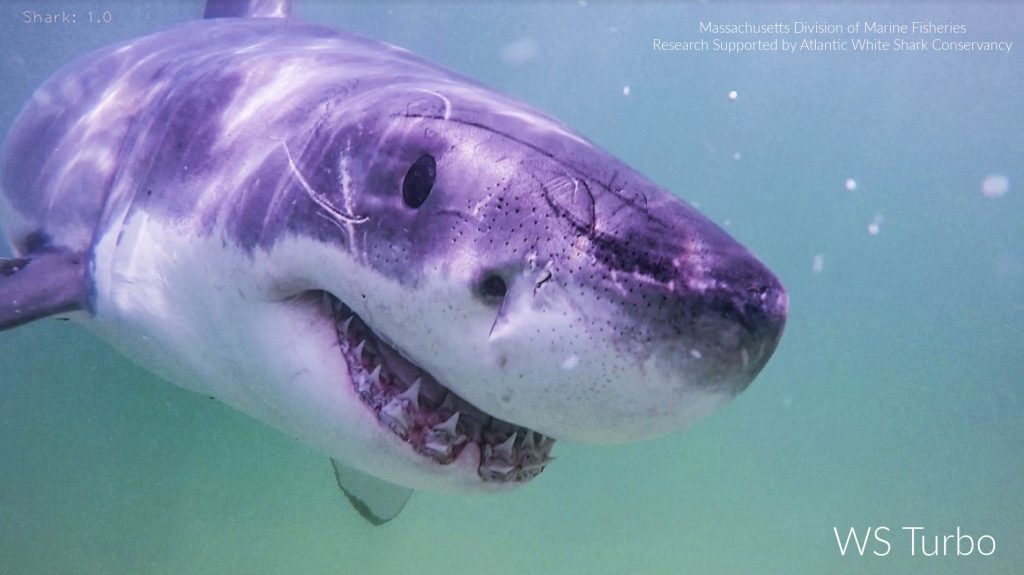
While white shark populations are extremely difficult to track due to their constant movement, scientists are sure of the fact that their populations have rebounded, increasing in the thousands since 1975. Sightings have increased, and it is well known that the population on Cape Cod has multiplied exponentially, growing in tandem with the seal population. White sharks have been spotted in South Shore waters near Hingham Harbor in recent years, as close as Duxbury, Hull, and Scituate.
However, white sharks are not out of the woods yet. There is still much research to be done, and conservation efforts to be carried out, before this species can truly be labeled as stable. You can help by supporting foundations such as the Atlantic White Shark Conservancy, spreading awareness through social media platforms, and making sustainable seafood choices.
Moreover, as the shark population increases in Massachusetts, we need to embrace some shark safety tips. Sharks do not actively search out humans as food. In fact, you’re much more likely to die from a lightning strike than from a shark attack. About 20 people are killed in the U.S. each year by lightning, whereas about one person dies every other year in the U.S. from a shark attack. However, as seal populations increase near shores and beaches, sharks sometimes mistake swimming humans as seals (we do look similar from underneath). Even though the risk of being attacked is extremely low, here are some actions you can take to reduce it even further:
- Avoid low visibility or murky waters
- Swim, surf, and kayak in groups
- Always follow the instructions of the lifeguard, if one is present
- Pay attention to beach signage; for example, if you see a purple flag with a white shark in the middle, that means sharks frequent the area
- Avoid swimming near seals, fish, or other shark prey
- Stay close to shore
If you follow these tips, you will have nothing to worry about, and neither will the sharks! Some mutual respect will go a long way toward protecting shark habitats while allowing us to enjoy the ocean. Happy beach days!

This is the latest piece for our local environmental contributor Charlie Inglis. He may only be in 7th grade, but he makes as much of an impact on the town as people who have lived here for generations. Charlie is a Green Living contributor for Hingham Anchor. When Charlie isn’t sharing his conservation and recycling tips, you might find him at Stars, Wompatuck or enjoying one of the countless athletic and arts activities he participates in.
Resources:
https://www.wbur.org/news/2025/06/20/jaws-50th-anniversary-shark-research https://www.atlanticwhiteshark.org/white-shark-public-safety
https://www.atlanticwhiteshark.org/white-shark-research
https://www.fisheries.noaa.gov/species/white-shark
https://sharkstewards.org/how-jaws-influenced-shark-perception/