
February 19, 2024 By Carol Britton Meyer
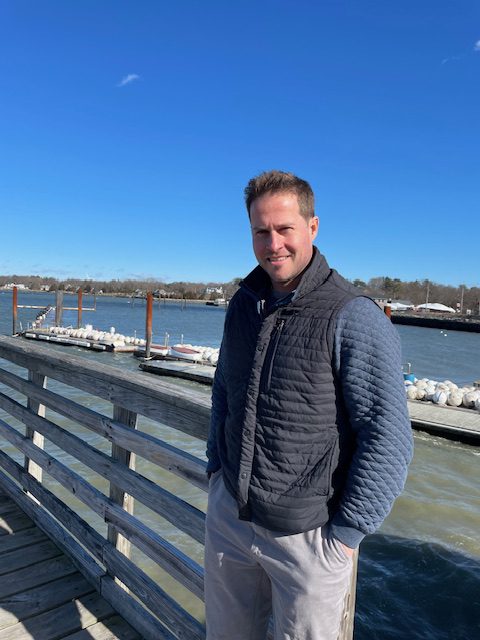
Hingham resident Sean Paylor has enjoyed eating oysters since he was a young boy, but it wasn’t until years later that he realized the environmental and ecological benefits they provide.
While his longer-term dream is to introduce aquaculture and oyster farming, in particular, to Hingham Harbor down the road — subject to a lengthy and complicated permitting process — his current hope is to establish an oyster nursery near the harbor.
This would involve the installation of an upweller to house thousands of baby oysters — called spat — that would be purchased from a supplier, or hatchery, located on Cape Cod, Paylor explained. After six months of growth within the upweller, in early Fall, the oysters would be released into their natural habitat, and within a designated area around Hingham Harbor.
At this time, the Department of Marine Fisheries (DMF) does not allow the farming or harvesting of oysters in any Hingham waters because the water doesn’t meet quality standards. “That crushed my oyster farm dream in the near term,” Paylor told the Hingham Anchor. Without DMF approval, such projects cannot go forward.
The oysters involved in this particular project would be used solely to help filter and clean Hingham Harbor water (a single oyster can clean up to 50 gallons of water per day under certain conditions) until a time — if any — when the DMF might allow harvesting of oysters for public consumption.
Paylor emphasized that this is just an idea at this point — a small step in cleaning the water and in helping to replenish the once-plentiful Hingham Harbor oyster stock that has dwindled to almost nothing over the years.
“The wild oyster population up and down the Atlantic coast (Hingham included) has been decimated over the last 200 years or so by pollution and over-harvesting,” he explained. “Sustainable aquaculture, or oyster farming, has largely served to fill the void that pollution and over-harvesting has created.”
MOP Executive Director Liv Woods further explained to the Hingham Anchor that not too long ago, millions of oysters lined the Massachusetts coast. “They protected our shores, provided safe homes to countless marine species, and helped to keep our water clean. Over time, industrialization and other human impacts have decimated the natural oyster population and the ecosystems they maintained.”
‘Nothing is set in stone’
Regarding his upweller proposal, “nothing is set in stone,” he said. “It’s the very beginning of the process. Aquaculture, particularly when involving oysters, is highly regulated in Massachusetts.”
Nevertheless, Paylor is forging ahead with his concept, working with the Massachusetts Oyster Project (MOP) — which supports several upwellers across Massachusetts — to gather information.
MOP is a non-profit working to strengthen the coastal environment by restoring native shellfish populations — including oysters — to beaches and coastal estuaries. “Through oyster cultivation, shell recycling, education, and advocacy, we can improve water quality, increase the diversity of sea life, and mitigate the effects of climate change,” the MOP website explains.
For the shell recycling program, MOP has collected more than 55,000 shells “that would have otherwise ended up in the landfill during our program on the Cape in 2023,” Woods said. “We are currently expanding our program throughout the Cape and would like to expand into the South Shore and eventually Boston. The shells we collect can be used in oyster restoration work and to help fight coastal erosion.”
MOP — which is committed to educating the public about the important role oysters play in the ecosystem and how their reintroduction into local waters can improve water quality, revitalize marine habitat, and strengthen coastal resilience — works with seaside communities such as Hingham where there is a desire to help their cause. “Hingham would be an ideal community for this kind of project,” Paylor said.
Upwellers are houses that grow oyster larvae before they are put into non-restricted waters approved by the Department of Marine Fisheries and the town shellfish constable, Woods explained. “Each upweller is sponsored by a town, club, or group. The upweller is cleaned, inspected, and data is collected on the growth of the oyster each day. Our upwellers can grow 60,000 to 120,000 oyster larvae to about 1 inch before release.”
Each upweller demonstrates how oysters “improve water quality, help grow oysters for our restoration efforts, and serve as important tools to get the general public interested in shellfish conservation,” the MOP website states.
Improving water quality
Because oysters feed by filtering algae from the water, they function as a natural filter and improve water that is overloaded with nutrients. In addition, they remove carbon and nitrogen from the water (the latter is used to form and grow their shells). The result is clearer and cleaner water that can support an abundant growth of underwater grasses — which provide a safe, nurturing habitat for juvenile crabs, scallops, and fish.
To install an upweller — contingent on the granting of necessary approvals — would require funding and volunteers to help clean out the upweller on a daily basis as well as a Hingham marina interested in hosting the upweller.
‘A perfect place to grow oysters’
Paylor explained that the idea to install one in Hingham Harbor came to him during COVID after his family had just moved to Crow Point.
“While working out of my home office, I would look out onto Hingham Bay and think what a unique neighborhood it is, surrounded by water,” he said. “During lowtide, the bay drains almost completely, and I thought it would be the perfect place to grow oysters since virtually 100 percent of the oysters we eat today are farmed, not wild.”
While the Harbor Development Committee listened to a presentation about upwellers at a recent meeting, the HDC has no authority on this type of project. The HDC is, however, the voice of “all things harbor” to the Select Board, HDC Chair Marco Boer told the Hingham Anchor.
In talking with some members of the community about the upweller concept, Paylor has heard overall positive feedback. “The wheels are in motion,” he said. “There’s a lot of momentum, and it’s a great thing to see.”
To help him understand more about oysters and the role they play in the environment, Paylor took online aquaculture classes at a local university during the pandemic, wrote up an aquaculture plan, visited oyster farms, and talked with oyster farmers. “Oyster farming is not my background!” he explained.
‘This would be a first step’
Approval for the installation of an upweller in Hingham Harbor would be “a first step,” Paylor said. “It wouldn’t clean the entire bay, but it could help replenish the oyster population and clean the water in the process. The irony in all of this is that oysters have been proven to clean the ocean, yet we are unable to grow them for commercial harvest or human consumption here in Hingham because the water isn’t clean enough!”
While this is a long way from his dream of establishing an oyster farm, Paylor remains open-minded. “Wouldn’t it be nice to see an operation similar to Duxbury’s Island Creek Oysters introduced at some point into Hingham Harbor on a small scale, which would benefit the ocean and the community at the same time,” he said. “Everyone loves Island Creek.”
Seaweed farm as well. I’m allergic to oysters.
What a great idea! A win win project for our town.