
March 18, 2026 By Carol Britton Meyer
The select board heard a presentation about proposed major future capital projects that will affect property taxes this week and also the good news that the proposed Fiscal 27 operating budget is balanced. Specific information about the tax impacts will be available at a later date.
Town Administrator Tom Mayo explained planned/proposed larger capital projects over the next 3-5 years outside of the ones of smaller scope/shorter-term that the capital outlay committee recommends every year prior to town meeting.
“The ultimate decision as to whether to present these projects that require borrowing as town meeting warrant articles rests with the select board,” Mayo noted. The advisory committee works closely with the board on all warrant articles.
The proposed/possible short-term and long-term capital projects presented by Mayo have different funding/borrowing timelines, some with authorization pending and others authorized but unissued – which means the money wouldn’t be borrowed until needed.
Some grant funding available
Grants are available for some of these proposed projects, including to dredge the harbor ($2-10 million overall cost range) as well as possible federal – and state construction – funding to help pay for construction of protective wharf walls at the harbor – which could cost an estimated $22 million. The timeline for that project could be FY31, Mayo noted, and “is largely grant-dependent. We’ll take advantage of all grant opportunities to offset the cost of these projects.”
The proposed future capital project estimates shared by Mayo include the proposed new Center for Active Living ($29.9 million); Plymouth River and South School roofs ($8.6 million as the town’s share after partial Massachusetts School Building Authority (MSBA) reimbursement); Hingham High School roof/mechanical work ($28.2 million, the town’s expected share based on 30 percent partial reimbursement from the MSBA, although that amount could go as high as 40%); inner harbor resiliency work in conjunction with the Route 3A improvement project down the road ($11 million, with authorization pending for $5 million of that amount); South Shore Country Club Pool, $8 million; $1.2 million for a fire truck; and $2.3 million for the high school roof feasibility study.
“In addition, the town will continue to strategically borrow and invest retained earnings in self-supporting enterprise fund capital projects for the Weir River Water System, sewer, country club, and the light plant,” Mayo said.
Town has ability to space out projects
Select board member Julie Strehle noted that the town “has the ability to space out these projects” while at the same time addressing infrastructure needs. She also praised town officials for their “aggressive pursuit of state and federal grants” for various projects.
At the end of his presentation, Mayo said that “there are no other substantial projects in the foreseeable future as I know it.”
While other large capital projects have been suggested by various people, “they’re not on my list,” he said. “Talking about them doesn’t make them real.”
Mayo also noted that beyond the above-mentioned projects, “the town would still have $100 million in debt capacity” considering that debt service expenses for some significant projects will “roll off” during the next five years. More information will be available at next week’s select board meeting.
Balanced operating budget presented
In other news, Assistant Town Administrator for Finance Katie Dugan presented the board with a proposed $173.06 million balanced operating budget – including $73.88 million for the schools – which they unanimously approved. Town meeting has the final say. The budget was balanced without having to use overlay or property tax mitigation funds, Dugan said.
The current Memorandum of Understanding (MOU) that extends from FY 2024 to FY 2028 among the select board, advisory committee, and the school committee caps annual budget growth to 3.5% on both the municipal and school sides.
Town Administrator Tom Mayo commended department heads for doing “a fantastic job putting forward their needs while understanding our budget constraints. The MOU was a good idea – it works well, although we had to make some tough decisions as we all do in our personal lives.”
Mayo went on to say he’s “thrilled” with the MOU and that “hopefully we can negotiate a new one that’s [also] good and healthy for the town. We’re not looking at a possible override in the immediate future,” he said.
The advisory committee will vote the operating budget on March 24.
“The town is in very good shape operationally and from a capital spending perspective,” Mayo said.
Personnel board report
Article 4 in the April 27/28 town meeting warrant will be the report of the personnel board.
This article includes the report and all the recommendations of the Personnel Board related to collective bargaining agreements (CBAs) and non-union employees.
For FY27, the motion proposes funding 3% COLA (cost of living) adjustments for non-union employees totaling $346,129, according to Dugan. “In FY26, the Article 4 funding was higher because it included the funding for settlement and changes to the police, fire, and DPW CBAs in addition to the annual COLA adjustments for non-union employees.”
The personnel board recommended a general wage increase of 3%, effective July 1, 2026, for employees not covered by collective bargaining agreements.
A hard copy of the warrant will be mailed to all households two weeks prior to the meeting, and an electronic copy will be available April 1 on the town website, including the proposed operating budget.
Go to https://www.hingham-ma.gov/241/Town-Meeting for details.
Tax impacts for specific projects outlined
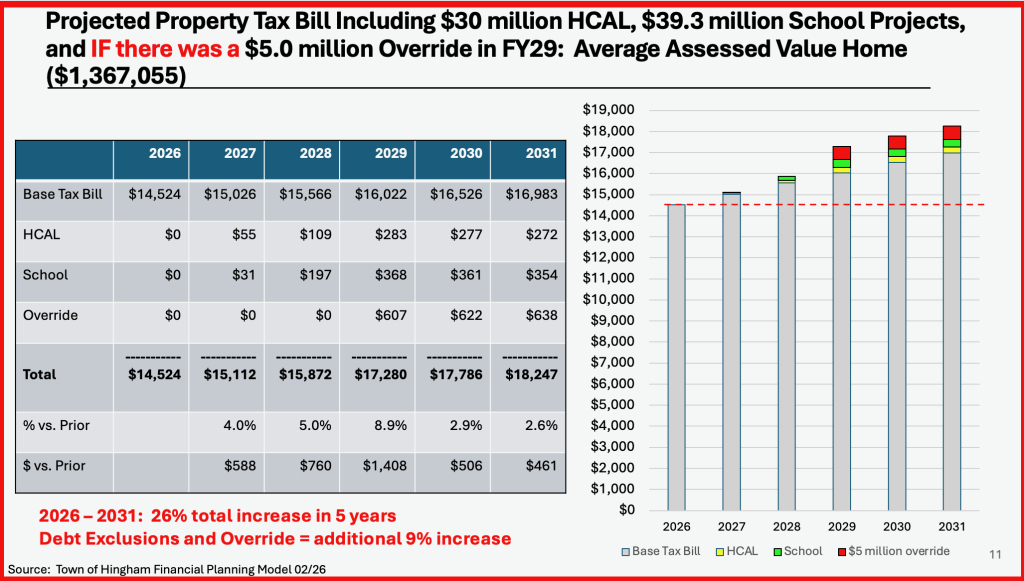
In related news, during their March 12 meeting, the advisory committee provided the below chart showing the tax impacts of several town projects in particular on taxpayers. (The fiscal year of any future override is not definite.) The source of this information is the Town of Hingham Financial Planning Model (Feb. 2026).