

August 22, 2025 By Carol Britton Meyer
The Center for Active Living Building Committee and some residents who were also present expressed enthusiasm following this week’s presentation of the exterior building and site design for the proposed project — adjacent to Bare Cove Park — by Chris Wante of EDM Studio.
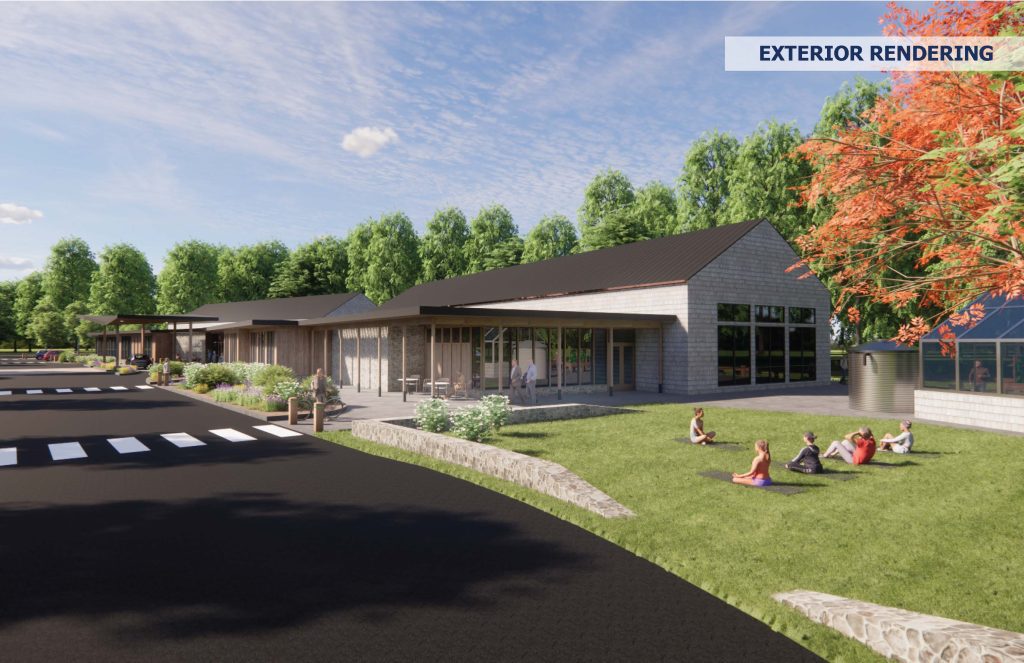
The design, which fits in with the surrounding park land and incorporates natural materials – including stone from the Plymouth Quarry — as well as the history of the park as a former military base features a “welcoming and accessible environment for all users and supports the center’s purpose of promoting the health and wellbeing of all users,” Wante said.
There’s also a plan to incorporate a sustainable approach to the design and overall maintenance.
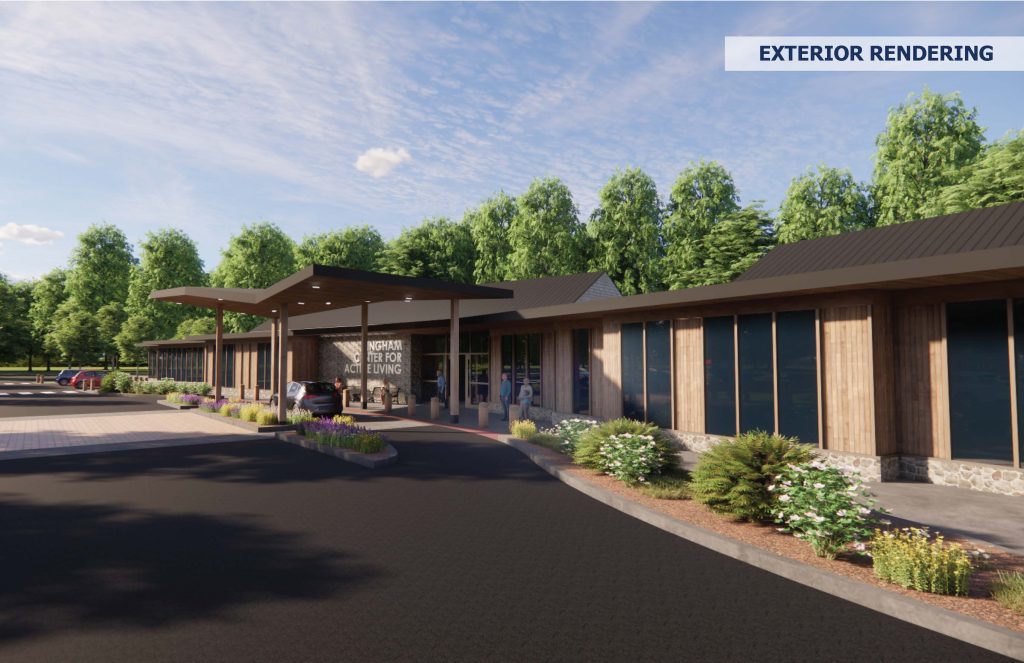
The size of the proposed one-story building – currently estimated at about $34 million — was recently reduced by about 10 percent, to 25,950 square feet.
The building is designed with large windows to let in the light and will feature program spaces at the back with views of the natural landscape. “Nature dictates building splits and bends based on the green corridor and site conditions,” Wante explained.
Features include cafe, media center, art space.
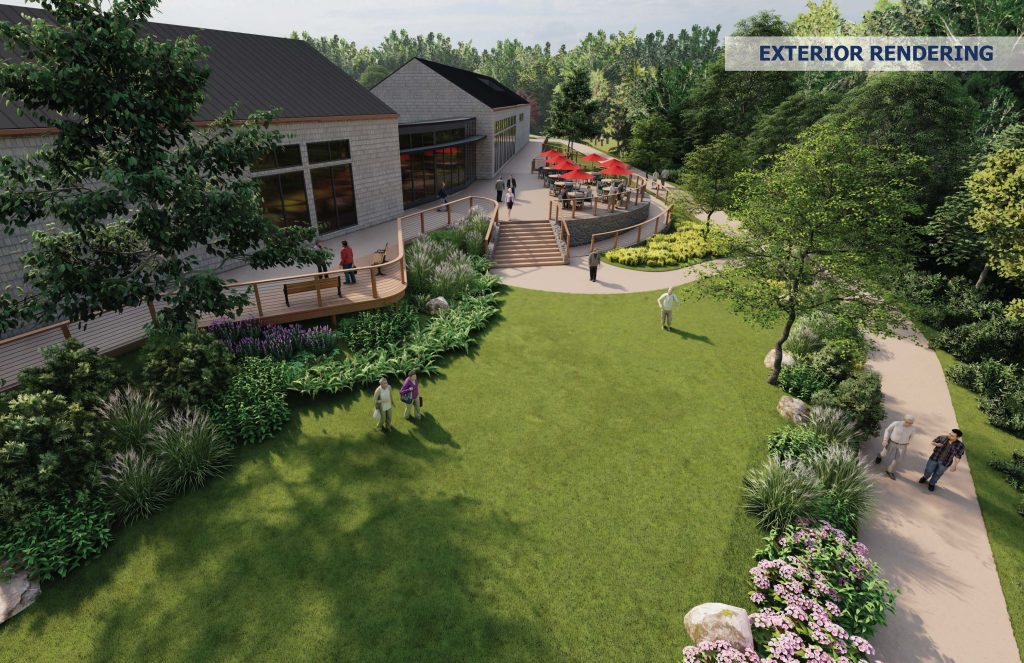
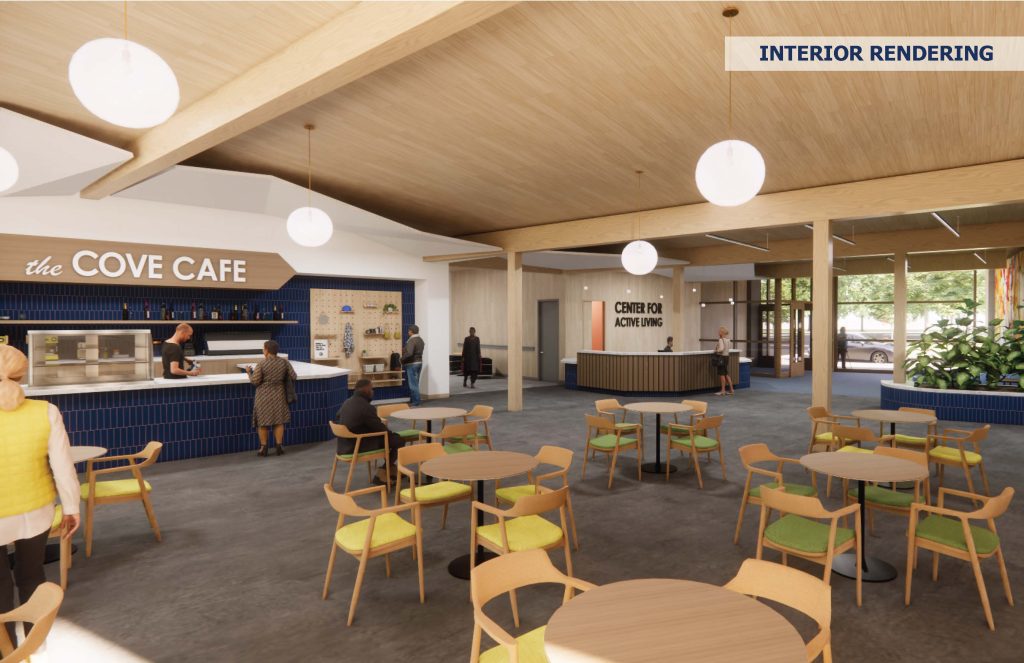
The design also includes solar panels, a landscaped canopy-covered entrance, roomy reception area, a cafe, media room, art space, a vegetable garden and rain gardens, a fitness room, a den with a fireplace, library, exercise studio, a patio to the rear of the building, a greenhouse, and new walking paths that will connect the site with “the scenic trails of Bare Cove Park and the [nearby] ball fields,” according to Wante. There will be about 160 parking spaces.
Building committee member Steve Young praised the “clean, light-filled” open feeling of the design. “Anyone would like to spend time there,” he said.
Chair Tom Carey said the originality of the design “fits the site” and likes the “classic New England touch.”
Resident Joe Nevins is pleased that a new CAL at this location would make Bare Cove Park “more accessible to citizens, especially those with mobility issues.”
‘The design is amazing’
Resident Yvette Kanter called the design “amazing. I wish my mother was here to see it. That’s why I’m here. I very much appreciate the respect for the park and bringing its history to life.”
When asked a question by Advisory Committee member Brenda Black related to the size and cost of the project, Carey responded, “People are asking questions before we’ve gotten there. They need to let the committee go through the process. We’ll be getting [updated] cost estimates down the road, which will hopefully answer the questions about cost.”
Black also asked if trimming the size back by 10 percent would affect planned programming.
“The [project] is smaller because we have done a lot of work finetuning the design and size,” Carey said. “No axe has been taken to the general consensus within the building committee as to the programmatic needs for a new Center. We should be revisiting all those things as we move down the road.”
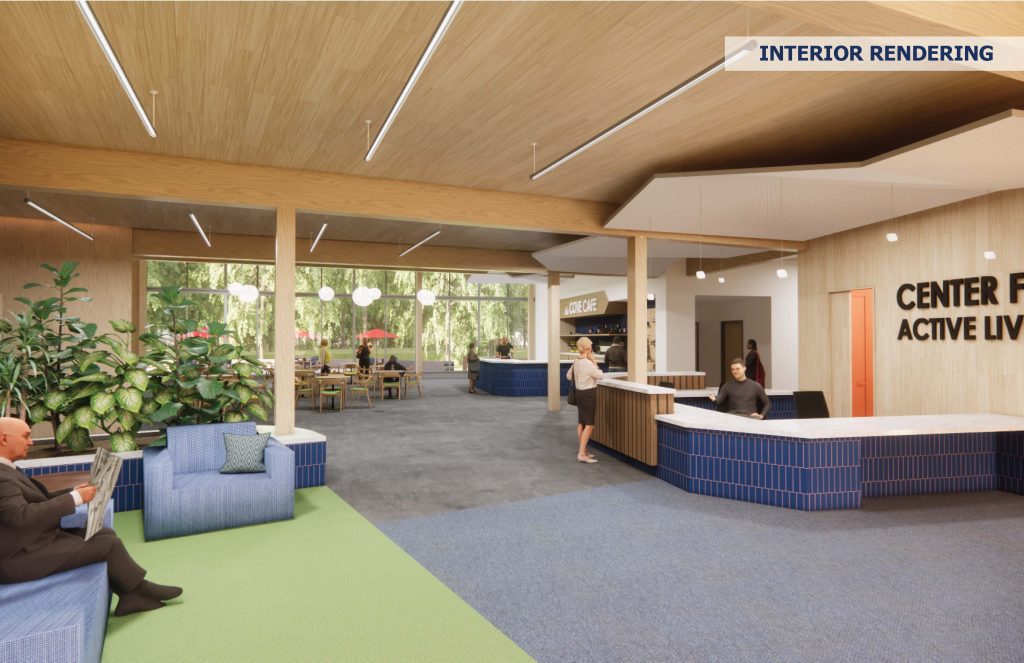
‘A beautiful building inside and out’
Resident Glenn Mangurian called the design “a beautiful building inside and out.” He noted that when he first learned about the proposed new CAL, he “believed it had to be a magnet center, and this is a magnet center. You couldn’t drive by it and not say, boy, what is that, and if you walked into it you would say the exact same thing.”
At the same time, “There [can be an] emotional reaction to its beauty – positive or it could be negative because omigosh, this must cost a lot of money,” Mangurian said.
He suggested that explaining the cost differentials “big or small” from using different materials from the ones currently included in the design, for instance, or “less glass and stone” could be helpful.
“The emotional reaction that this beautiful building must cost a lot of money isn’t necessarily true, but the answer to that question needs to be in your hip pocket,” Mangurian told the committee.
Those issues will be addressed “down the road,” Carey said. “We haven’t loaded this [proposed project] up with a bunch of frills.
Near the end of the process, once we get the bids, there will inevitably be a squeeze to see where some savings can be realized.
The committee is well aware that everyone in town is watching the costs, as are we — and as we have been doing all along.”
The next building committee meeting is Tuesday, Aug. 26, at 5:30 p.m. at the Center for Active Living at 224 Central St. and will feature a conversation about the sustainability of the design.
Town Meeting will have the final say on the proposed new CAL.
For more information, go to https://www.hingham-ma.gov/1080/Center-for-Active-Living-Building-Projec
More Rendering Photos Below:
The plans are beautiful. Now how about redoing the Hingham senior housing? It is deplorable that a town like Hingham does not support senior housing on Thaxter str. Why is Quincy in charge of our low income apartments??
I have ben following Town affairs since I registered to vote in High School in 1971 and I have learned that in 1980 voters passed Proposition’s 2 1/2 which means that the town of Hingham cannot spend more that 2 1/2 of the total assed value of all taxable property. The people who work and volunteer for the Town of Hingham work very hard to stretch the budget. Having Quincy combine services saves the Town money.
Ms. McRae –
It continues to surprise me that there is a fundamental misunderstanding about the Hingham Housing Authority (“HHA”) and its operation and properties in relation to the Town of Hingham. The HHA is a separate state entity rather than part of Town of Hingham government, and as such the Town is not obligated to fund the HHA housing unless by separate contractual arrangement. The essential governmental funding for the HHA comes from the state and federal government. My understanding is the state agency with oversight of the HHA is the Executive Office of Housing and Livable Communities; and there has been a policy implemented by that agency to encourage if not require local HAs to adopt a regional administrative operation structure if only to serve the objective of efficiencies, thus the involvement of the Quincy HA with the Hingham HA. See this link: https://www.mass.gov/resources-for-local-housing-authorities-and-board-members?_gl=1*nuag1i*_ga*MTQ3NDE1MTg0Mi4xNzMxNzEzOTM0*_ga_MCLPEGW7WM*czE3NTYxNjg5MTEkbzIkZzEkdDE3NTYxNjg5MTckajU0JGwwJGgw
It is not accurate to say this site is adjacent to Bare Cove Park. There are many Town records, including John Richardson’s records as the first Chair of the Bare Cove Park Committee, clearly delineating Building 14, and the beautiful forest that surrounds it, as within Bare Cove Park. More importantly the best way to respect the park is to let it be and not irreparably cut down its trees, some of which have been growing for over 100 years, and not eliminate more habitat for the birds and wildlife. Where did the Hingham go that I thought loved its natural green open spaces?
Hingham still loves its natural green open spaces that are so important to our physical and emotional well-being! World’s End has ocean views, an arboretum, and Olmsted-designed walking trails. Wampatuck State Park has bicycling routes and a campground. Bare Cove Park has wildlife and wide, paved walking paths along the Weymouth Back River estuary. These plus residential green space makes Hingham a very special space to live and work.
However, I agree with you that the Hingham Center for Active Living (HCAL) should NOT be built within Bare Cove Park.
1. Large beautiful windows like those in the HCAL design are totally inappropriate inside a wildlife sanctuary. Because birds don’t recognize glass panes, they smash into them. Glass windows have killed millions of migrating birds! Since Bare Cove Park is home to over 100 bird species, and is a key stop on the Atlantic migration flyway, the HCAL building with its wonderful glass windows should not be built anywhere near Bare Cove Park.
2. The HCAL plans call for cutting down almost 4 acres of large trees in Bare Cove Park and replacing them with pretty ornamental trees, grass, and asphalt. This will have a devastating effect on wildlife for several reasons: A) Each large tree produces more oxygen than each small tree and provides more shelter and food; B) Wild birds, especially eagles, osprey, and egrets, sleep high off the ground at the top of tall trees; C) Dead trees are particularly popular “apartment homes” for insects and woodpeckers, while chipmunks like logs and holes in the ground.
3. We should move the HCAL to the golf range now, while it is still in the design stages!
This is a wonderful design. I particularly like the terrace in back overlooking lower land. However, the renderings make it clear that many acres of hardwood forest in an area of critical environmental importance (ACEC) will be replaced by grass, asphalt, and landscaping for humans rather than wildlife.
I would like to see this design adapted to the empty Hingham Golf Range instead.
Hilary Hosmer
The town-owned Hingham golf range is centrally located on Union St and has 11 acres of land, sufficient for both the Hingham Senior Center building and parking. Its long layout fits the new designs. Trees here have already been cut, so building here would not as devastating to the environment and wildlife as building in Bare Cove Park would.
Because the golf range is town-owned, it does not have all the stakeholders that Bare Cove Park has, including the Back River Watershed Committee, the Hingham Conservation Committee, the Bare Cove Park Committee, and the State Legislature which must approve the A97 swap. Hingham’s golfers can practice at another golf driving range in Hingham on Route 53.
Totally agree with this. Hingham Golfers are few and far between, compared to the impact this senior center will have on elder residents. This space off Union Street is a wonderful location, already cleared of trees, flat and open space, easy to access, more centrally located to our residents, and has wonderful access to Triphammer pond and nearby Wompatauk. This is a GREAT alternative to Bare Cove Park, which needs to be maintained as an ecological site for all creatures.
“When I first moved to Hingham Woods in the mid 1990s, I was awakened each morning by a loud chorus of birds. No longer, alas. The Audubon statistics on the loss of song birds are frightening. Here the management heavily sprays insecticides, herbicides, fungicides indiscriminately—destroying food for many bird species.
I think the new CAL, on top of a swamp and nestled in a forest, will have to spray, spray, spray too if anyone is to enjoy those terraces. Lots of mosquitoes and ticks!”
Mary Ann Jackson
“Native oaks are the most valuable tree for wildlife in 84 percent of the counties in the United States in which they occur,” says Doug Tallamy, a University of Delaware entomologist and author of the 2021 book The Nature of Oaks. Yet the CAL plans to clear cut about 4 acres of well-established oak trees!
One of oaks’ most important benefits, Tallamy says, is that they are the host plants for more than 1,000 kinds of moth and butterfly caterpillars. These Lepidoptera larvae, in turn, are the most important protein that virtually all parent songbirds need to successfully raise their offspring—from cardinals and chickadees to wrens, vireos and thrushes. By contrast, native birch trees host just over 400 caterpillar species, while elms host about 200. No wonder we hear so many song birds under the mostly oak canopy at Bare Cove Park!
Based on Tallamy’s research, the National Wildlife Federation’s Garden for Wildlife® program features oaks on its online lists of keystone native plants for 10 North American ecoregions. A small subset of all kinds of native plants, keystone plants are those that are vital to the life cycles of many different wildlife species and therefore to the food webs that support entire ecosystems.
The proposed Center for Active Living would cut down the large oak canopy and replant smaller 3 inch in diameter trees in the parking lot plus a few purchased expensive large 8-inch in diameter trees.
Moving CAL to the golf driving range would eliminate the loss of oak trees and wildlife, as well as the expense of purchasing replacement trees!
Yes the center design is beautiful but completely inappropriate for a setting in Bare Cove Park. It will have a very negative impact on the environment and wildlife in Bare Cove. I completely agree with the comments that the center should be moved to the Hingham Golf Range.
I wondered why the HCAL building committee was told to review only two sites, Town Hall and Bare Cove Park. I found the answer in a recording of the Select Board meeting of August 15, 2023. See video https://m.youtube.com/watch?v=5MJP5TPX2YM. The relevant HCAL discussion starts 1 hour into the meeting and lasts until 2:10.
To summarize, the board considers 5 possible sites in a very well-informed manner. Town Hall (1) is included as a site to review, because that is where the current Senior Center is and because space has been freed up in the police and fire building and lots. Bare Cove Park (2) is included as a site to review because no one advocates against it. No one mentions building next to a swap, or clear cutting trees that support wildlife. Select Board member Joe Frasier opposes building at the golf range (3) “because it is the only free golf range in the area” and golfers who use it will protest. Select Board member Bill Ramsey opposes building at 2 Beal St. (4) because Beal St. is a high traffic area and it would be better to put a low-traffic project there, like 6-8 units of housing for people with accessibility issues. All agree that the National Armory (5) is too small. Select Board chair Liz Klein recommends proposing just two sites to the HCAL Building Committee, so that the sites can be examined in depth with the allocated funds.
Hence, the HCAL architects presented very detailed alternatives of the two proposed sites, but did not study the Hingham Golf Range, the most appropriate location.
There will be a chance to speak up at the Tuesday Sept 9, 2025 meeting of the HCAL and the Select Board at 5:30 PM.
I hate the idea that this project will destroy a large chunk of Bare Cove Park, which is very precious to me. I hope that this project will fail. I certainly will be very firmly against it. If a new senior center really is needed (which seems very questionable to me) it must be put somewhere else.
I strongly agree that this project should not be located in Bare Cove Park. The disruption to wildlife and removal of trees of this magnitude is unacceptable.
I further support a more central location for this project as well as a smaller scale design.