

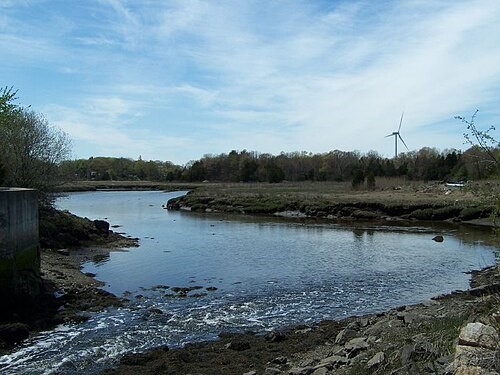
The Weir River from Hull looking East
August 25, 2026 Submitted By Hingham Resident John Borger
The Weir River Water System’s recurring summer water shortage is not our most serious problem. Federal and state regulatory agencies have imposed overlapping mandates limiting the amount of PFAS (“Pea-Fass”) compounds (aka, “forever chemicals”) in drinking water. The looming federal compliance deadline poses a daunting challenge to the system – and our finances. This is a complex picture with many moving parts, but, after trying to educate myself one level beyond buzzword conversancy, I have attempted a primer for us below.
First, let’s review the chemistry. What are these PFAS compounds? Why are they dangerous for human health?
Think of the PFAS classification as a massive family tree containing from 4,000 to over 14,000 related compounds, all with an appalling trait – they mostly never break down. They have a “half-life” of 2-5 years, meaning it takes that long for the human body to reduce a given baseline concentration by half. Because we take in more PFAS each day than we can eliminate, they accumulate to increasing levels over our lifetimes. They cause severe medical problems, including disruption of pre-natal development, impaired immune function, and cancer. Since PFAS chemicals originated in the 1940’s, they have been in vast industrial use ever since to repel heat, water, oil, and stains, and have thoroughly permeated our ecosystem. The first generation can be divided into two types:
Per-fluorinated – “per” meaning “fully” – as in fully saturated with fluorine atoms. These feature unbreakable chemical bonds – they last forever, thus the shorthand, “forever chemicals.”
Poly-fluorinated – “poly” meaning “partially” – as in partially saturated with fluorine atoms. These have a weak link in the chain, which means they can eventually break down. The bad news is that they then morph into a “per” chemical – the kind that last forever.
The EPA Regulations
The federal Environmental Protection Agency regulation is focused on two of the first generation “per” (fully saturated) strains:
PFOA (Perfluoro-octanoic Acid) – Historically used to manufacture Teflon, non-stick cookware, and water-resistant fabrics.
PFOS (Perfluoro-octane Sulfonic Acid) – Historically used in Scotchgard, stain repellents, and heavy-duty firefighting foams (AFFF) used at airports and military bases.
Both chemicals incorporate “octan” in their names, signifying that they have 8 carbons in their make-up (i.e., they are “long-chain”). The EPA has mandated a maximum of 4.0 PPT (Parts Per Trillion) of these chemicals in drinking water and has advanced a rule to move the original compliance deadline from 2029 to April 26, 2031, for water systems requesting the extension.
The MA DEP Regulations
Over time, industry has attempted to ameliorate the “forever” problem by replacing the two primary, eight-carbon, “long chain” compounds with second generation substitutes of varying carbon configurations that were thought to break down more easily (and thus not “bioaccumulate” forever in our bodies). That has proven not to be the case.
The Massachusetts Department of Environmental Protection (DEP) rules target the original PFOA and PFOS chemicals, plus the most prevalent four replacements (PFHxS, PFNA, PFHpA and PFDA), in a larger basket termed the “PFAS6.” Because the 2nd generation substitutes have proven to be as problematic as the original compounds, the MA DEP mandate establishes an aggregate maximum limit of 20 PPT for the PFAS6 basket.
Are We in Compliance?
The good news is that WRWS sampling to date shows that the system has been consistently in compliance relative to the DEP mandate limiting the PFAS6, although that could change as steep drawdowns leach more PFAS into the ground water. The bad news is that samples move in and out of compliance for the federal EPA mandate limiting PFOAS and PFOS to 4.0 PPT, with WRWS results ranging from 1.0 PPT to 5.0 PPT and higher. What’s worse, different PFAS chemicals have different properties relative to filtration techniques, meaning that a treatment effective for PFOA and PFOS chemicals may not be as effective for the other four. To move reliably into compliance with pending EPA regulations, while staying in compliance with DEP rules, the WRWS will have to choose from three filtration technologies, each of which has significant downsides and high price tags ($15-30 million).
Granular Activated Carbon (GAC) – Water is pumped through massive beds of highly porous, baked bituminous coal or coconut shells. GAC is highly effective for PFOA/PFOS, but not for the 2nd generation compounds. GAC has the highest capital expense, the lowest operating cost, and the highest physical footprint. (The WRWS already uses GAC, but in a limited way designed to remove organic material, taste, odor, and chlorine disinfectant, still allowing enough PFOA/PFOS through to frequently exceed the EPA maximum.)
High-Pressure Reverse Osmosis (RO) – Requires chemical pre-treatment and complex, automated, high-pressure, multi-stage pump networks to force water through multiple membrane configurations. RO is effective against all PFAS, but has high capital cost, the highest operating cost, and a large physical footprint.
Anion Exchange (IX) – Manufacture of synthetic resin beads imparts a high, positive charge, which enables them to bind contaminants like PFAS (which have a strong negative charge) for removal. IX is highly effective against the PFAS6 compounds, has lower capital expense, medium operating expense, and a relatively smaller physical footprint than the other two.
There is No Silver Bullet
Each of these filtration technologies has varying effectiveness profiles; each has capital and operating cost trade-offs; each will have an implementation runway perilously close to the five years at best that we have for EPA compliance. Connection to the MWRA is not a viable alternative strategy for EPA compliance because connecting will take even longer for application, approval, engineering design, and pipeline construction, with each phase ploddingly orchestrated within a six-town consortium. And it won’t be free – costs will run to many millions of dollars, for the application fee, initial capital expenditures, and ongoing MWRA charges. It seems clear that protecting our community from the health risks of PFAS chemicals and staying reliably in compliance with both the EPA and DEQ regulatory regimens will require advanced local filtration, estimated to cost $15-30 million.
Whatever strategies we choose, we have to accept that in the future, water in Hingham will be increasingly precious, a community resource held in common that we must price at its true value to encourage conservation. Recurring massive, seasonal drawdowns of water that suction more PFAS into our aquifer must stop. It will be lunacy to squander millions of gallons of expensively filtered water on grass. Culturally, we need to find alternatives to the lush green lawn, embracing drought-resistant indigenous ground covers and attractive permeable materials, as Phoenix and other cities in the Southwest have done. We are on an inevitable collision course with the hard realities of both sustainability and affordability. We must adopt disciplined measures to end Hingham’s tragedy of the commons, just as our colonial forebears did. We must all become better stewards of the commons.
Next up in Hingham H2O: Part 4 – the nature of our aquifer, how the WRWS wells work, and how massive seasonal draw-downs suction more PFAS into our water.

John Borger has lived in Hingham for 37 years and has been active in the Town’s fight against climate change and its quest for sustainability.
This series has been successful towards raising a long overdue red flag relating to the “Daunting” challenges and issues facing Hingham as well as, the entire South Shore of Massachusetts! The increasing demand and cost for safe potable water is outpacing water supply. Beginning in the 1950’s a building boom has taken over and changed the entire water ecosystem by reducing a significant landmass to development. The repercussions are now becoming evident. Alteration of natural terrain has dramatically reduced the pervious areas that once allowed surface water to penetrate the ground. Degradation of water quality due to contamination is becoming a more recent issue. The life cycle of water infrastructure is not a one-time installation. Ongoing repair, maintenance and the eventual replacement of all types of specialized equipment comes with a major cost.
My compliments to John Borger for this excellent series of factual postings!!!!
I am a 71-year-old native of Hingham and have grown-up witnessing the detrimental effects of Urban Sprawl, which have taken over the South Shore as well as, most of eastern Massachusetts and beyond. Groundwater and Surface Waters have no Municipal boundaries. Alteration of terrain along with untreated wastewater from private septic systems have contributed to the contamination of our water resources.
This entire issue of declining potable water supply and water quality, over extraction of groundwater, the detrimental result of landfill contamination, surface water contamination, loss of pervious soils from large tracts pf pristine land, wastewater injection back into the earth from industrial facilities, highway drainage system runoff containing all the crud from rods. Where are we headed???
I totally agree with the John’s insight into this issue. We a facing a calamity of a magnitude this world has never experienced.