

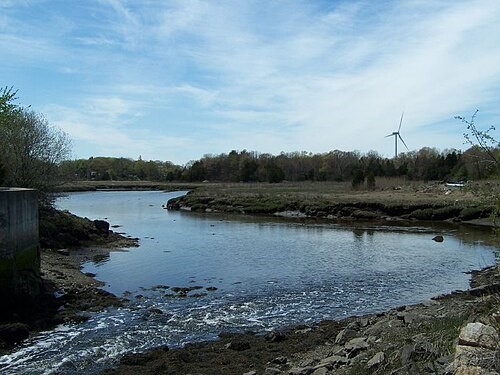
The Weir River from Hull looking East
August 18, 2026 Submitted By Hingham Resident John Borger
Glen Mangurian’s recent post summarized the stresses currently impacting Hingham’s water supply. Hotter, drier summers are stressing the Weir River Water System (WRWS) to its limits.
To date, the WRWS Commissioners’ response to seasonal water shortages has been to appeal for voluntary conservation and, when this predictably fails, to impose bans on most outdoor water usage. The recurring annual necessity of a Level 2 water ban in June is irrefutable evidence of the ineffectualness of these appeals.
In my previous post, I observed that Hingham’s water shortages exemplify “the tragedy of the commons,” with the associated vulnerability to overuse by some consumers. We cannot control the weather, but we do control the rates charged for this precious commodity we hold in common. The WRWS rate structure is unconscionably regressive, punishing lower income households using moderate volumes of water for basic living, while subsidizing wealthy consumers who abuse the commons by squandering huge quantities on their lawns. We can do a far better job of pricing our water to encourage conservation.
The WRWS Rate Structure
The WRWS currently levies up-front administrative fees and a rudimentary two-tier residential rate structure applied to actual water usage. On July 1, 2026, the WRWS implemented an increase of 3% to its two rate levels. WRWS also implemented a flat $65 annual capital assessment per household on top of its monthly $80 service fee. In addition to these fixed charges, the WRWS applies this volumetric rate structure:
– The Tier 1 (“Base Allowance”) rate of $3.721 applies to the first 12 CCF (Hundred Cubic Feet) per quarter. CCF stands for Centum (one hundred) Cubic Feet; one CCF = 748 gallons.
– The Tier 2 (“Excess Usage”) rate of $4.588 applies to all usage over 12 CCF per quarter.
Together with the large, fixed fees, this constitutes a shockingly regressive approach to pricing. First, households must pay fixed charges totaling $1,025 a year before they use a drop of water. Second, the higher tier rate kicks in at an extremely low threshold—just 12 CCF (8,976 gallons) per quarter. Data from the EPA and the Water Research Foundation sets non-elective, normative consumption for bathing, drinking, cooking and cleaning at 60 gallons per person per day, which translates into a 4-person household usage rate for a standard 91-day billing quarter of around 29.2 CCF – 2.4 times the WRWS threshold for the higher rate.
Because the WRWS Tier 2 threshold is so low, even the most water-frugal, non-irrigating family of four quickly crosses into the higher tier purely for everyday necessities. WRWS pricing does not differentiate between a conscientious household using water sparingly and a luxury consumption outlier squandering huge volumes to have a lush, green lawn. (Remember, irrigation guzzles 35% of the system’s water). Both households end up paying the same rates for their water. The WRWS pricing scheme loads the system’s financial burden onto average users while failing to create a meaningful price disincentive for heavy consumption. Is this fair, or effective?
To incentivize conservation, we need a calibrated, multi-tiered rate model. Ideally, this structure would apply the Tier 1 base rate to a quarterly volume sufficient for normative household use, keeping the cost affordable. However, in the higher tiers calibrated for higher levels of usage that reflect consumer choice, marginal rates would steepen sharply.
Research from organizations like the American Water Works Association (AWWA) confirms that volume-based tiered rates successfully curb peak summer outdoor demand. The Commonwealth of Massachusetts explicitly advises public water utilities against rudimentary flat, or weakly stepped rate structures like Hingham’s. According to the Water Rates Guidance at Mass.gov, utilities should use aggressive conservation pricing to “better match prices to the true cost of providing water,” “promote water conservation,” and “help shift demand away from peak times to reduce stress on the system.” Federal guidance in the US EPA Water Affordability Framework explicitly recommends a multi-tier, “increasing block rate” to protect affordability.
Just next door, Scituate utilizes a steeply increasing four-tier system in which the highest consumption tier charges excessive users nearly double the base rate to discourage profligate consumption. In contrast, the WRWS higher tier rate is only 27% greater than the base rate. Scituate’s tiered rate structure has lower fixed charges and a Tier 1 rate that is 20% lower than Hingham’s, making water more affordable for households using moderate volumes. Scituate’s tiered rates have flattened peak summer demand while generating proportionately much higher revenue from the obdurate 4-5% luxury users who cross into the highest two tiers, financing more than $5 million in capital improvements to date.
Further south, the Cotuit Water District implemented tiered water rates in 2019, significantly raising rates for high-volume users. This yielded immediate results, leading to further rate adjustments in 2024. Between 2020 and 2025, the Cotuit Water District estimates it reduced summer water pumping volumes by as much as 40%. The Cape Cod Commission is currently studying Cotuit’s impressive results.
For wealthy households indifferent to price who persist in excessive consumption, the steeper tiers would serve the community purpose of generating additional revenue, as in Scituate. Luxury consumption outliers would fund WRWS treatment plant upgrades like those that will be necessary for expensive PFAS filtration (estimated at between $15 and 30 million), at a level more commensurate with the stress they impose on the system. The WRWS currently forces all ratepayers to shoulder these capital costs equally. In a town where 24% of over-65 households make do on $25,000 or less a year, this is simply indefensible. Note that WRWS offers zero rate relief to low-income households and seniors.
Current Rates Are the Anachronistic Residue of Aquarion’s Financial Incentives
The rate structure WRWS inherited made sense for an investor-owned utility (IOU). Aquarion had an exclusive license to sell water priced at cost, plus profit. Maximizing returns to investors entailed selling as much water as possible. A rate structure calibrated to incentivize conservation would have depressed sales – and profits. Plus, IOU’s make part of their money from guaranteed returns on capital investment. Need more water to sell? Build a pipeline and buy Quabbin water – on a cost-plus profit basis.
In Summary…
The WRWS has done a good job of holding the line on rate increases in the five years since acquisition of the system. The Commissioners—who were elected as Hingham’s Select Board and deemed Commissioners— have only recently approved the first rate hikes for the two tiers, as well as a capital assessment to fund vital structural maintenance, such as the Strawberry Hill and Turkey Hill tank rehabilitations. They have attempted to be proactive in implementing moderate restrictions on irrigation at the very beginning of the season in the form of the odd/even address scheme. Although that regimen has clearly failed to curb irrigation-driven draw downs, they have so far declined to initiate universally recommended, steeply tiered pricing to discourage high consumption. This needs to be vetted by the WRWS Citizen Advisory Board and ultimately, Town Meeting. Shouldn’t we get started now?
Structuring rates to discourage excess consumption may not be politically popular with everyone. But high-volume consumers need to acknowledge the community’s need for affordability for lower income households, sustainability of the town’s water resource and public safety. The urgent, automated messages from WRWS underscore that we have a critical problem. Fire Chief Steve Murphy is not crying wolf when, concerned about water pressure for firefighting, he issues dire warnings like “”I cannot overstate how serious the situation is.”
But wait – won’t tying into the MWRA Quabbin reservoir supply solve all our problems, including the looming compliance deadlines for reducing PFAS chemicals in WRWS water? A potential (and expensive) MWRA supplement 10 years out does not justify inaction now. Meanwhile, chronic seasonal drawdowns cause more PFAS chemicals to leach from sediments into the water. I’ll explore these issues in subsequent posts.
Research data, government guidance and peer-town precedents all provide strong support for steeply tiered rates; an irrigation rate classification already exists. What’s needed is a Town-wide commitment to sustainability, affordability, and the civic fortitude to deploy more equitable, effective rates. We need to honor the traditional Hingham value of fairness by shifting the burden of conservation away from struggling households and onto the highest-volume outliers. The Commissioners, together with the Citizen Advisory Board, can initiate the changes required to remedy this tragedy of the commons, just as our Puritan forebearers did. Will they?
Coming in Hingham H2O, Part 3 – the looming PFAS compliance deadline
– John Borger
You can view Hingham H2O, Part 1 here: https://www.hinghamanchor.com/opinion-hingham-h2o-part-1-the-wrws-level-ii-ban-exemplifies-the-tragedy-of-the-commons/

John Borger has lived in Hingham for 37 years and has been active in the Town’s fight against climate change and its quest for sustainability.