

July 23, 2026 by Charlie Inglis, Hingham Anchor Environmental Contributor
Food is a basic human necessity, a way for people to come together, and one of life’s pleasures. But sadly, about 35% of the American food supply is wasted. Discarded food accounts for approximately 22% of total waste in the United States. The average family of four throws away over $1,500 a year in wasted food. And the environmental impact is significant: 8-10% of global emissions come from food waste. According to Janice McPhillips, Co-Chair of the Cleaner Greener Hingham Committee and a Farm Educator at Holly Hill Farm in Cohasset, “The Massachusetts Department of Environmental Protection estimates that the state will run out of places to put our trash by 2030, requiring expensive hauling of trash to landfills as far away as Pennsylvania and Ohio.” The amount of energy and money wasted in the production of discarded food, along with the methane released as it rots in landfills, is atrocious. And what’s truly unforgivable is the fact that hundreds of millions of people worldwide are hungry. We must take action to reverse this trend, and luckily, there are many ways to do so. One of the most effective and efficient is composting.
Composting is a fairly well-known means of reducing food waste by decomposing food and turning it into ready-to-use soil. However, composting is not as widely used as it should be. Only 27% of Massachusetts schools compost, and 12-15% of Massachusetts households compost. This is a missed opportunity not only to minimize our waste, but to recycle it into useful soil that can be used to generate more food. I recently learned about the opportunities – and challenges – involved in establishing a new composting system. Over the past semester, I implemented a composting system as an eighth grade capstone project at the Sage School. My partners and I calculated that our small school generates about 184 pounds of food waste each week. Thanks to many hours of research, coordination, and implementation, Sage now has a composting system in place. The program reduces food waste by 100%, and when plates are included, by 95%. This is a momentous step forward for both the school and for myself; I am grateful for the opportunity to combine my desire to contribute to my school community with my love for the environment.
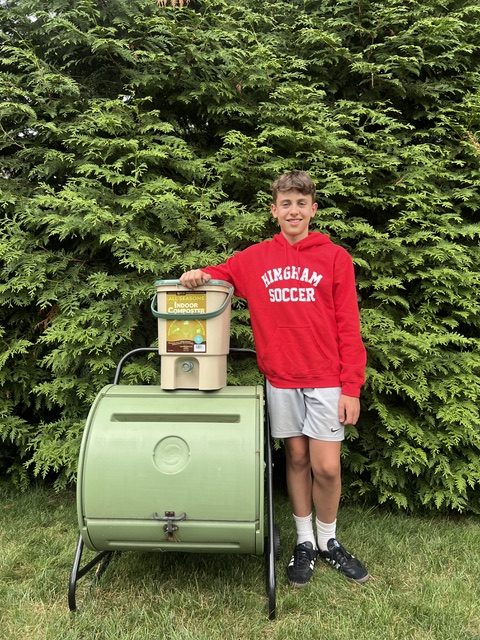
I learned a lot about composting over the course of this project. There are different methods of composting, and most are designed to handle different foods. For example, our school-based composting system uses both tumbler compost bins and bokashi bins. Bokashi composting is a method that originated in Japan, and is extremely valuable for households and schools. Instead of directly decomposing the food into soil, bokashi bins are airtight containers that allow food to ferment. The fermenting process means that bokashi bins can handle various substances that most composters cannot, such as meat, acids, and dairy products. Bokashi bins turn food into a slightly more liquefied, sludge-like mixture that is put into a second kind of composter: tumbler bins. Tumblers are one of the most common methods of composting, and are highly effective in converting food into soil, but they cannot handle many of the foods that bokashi bins can. Both of these styles of composting each take about 2-3 weeks to complete a full cycle.
The breadth of foods that Bokashi composting can handle makes the process easier and more effective. As Hingham Green Team member, Cleaner Greener Hingham Committee member, and former science teacher Peter Swanson states, “Bokashi composting is fun and easy.’” Peter sells repurposed Bokashi composting systems to support schools and sustainable practices in Honduras. If you wish to purchase such a system from him, please reach out to him at pswansonqhs@gmail.com.
Composting has stood the test of time, having been used for millenia. Archeological evidence suggests that people in Scotland used early forms of composting up to 10,000 years ago. Composting is still just as important and effective as it was then, and I highly encourage you to implement a composting system in your home. Here in Hingham, there are multiple ways to start. Two of the easiest methods are backyard composting and ‘curbside composting,’ a simpler and less hands-on option. The town of Hingham is helping to facilitate backyard composting by selling New Age Composters at the DPW for the deeply discounted price of $25. Alternatively, curbside composting allows you to gather your food scraps in a bin, which is placed on the curb for pick up, and participants have the option to receive a portion of the composted soil. Hingham has partnered with Black Earth Compost to provide discounted curbside composting to residents; you can find out more about the program on the Town of Hingham Website, or on the Black Earth Compost website.
Progress is being made here in Hingham. Over the past few years, various zero-waste events have taken place around Hingham, with all single-use items being compostable. Organizations such as the Hingham Yacht Club, Hingham High School, and Hingham Light have all hosted gatherings where no materials were thrown into the garbage. This is a significant step in the right direction. In my own home, we have recently adopted both the Bokashi and tumbler methods of composting, and have discovered how easy and satisfying it can be.
No matter which way you compost, the important thing is that you do it! The world produces over a billion tons of food waste annually, and composting is one of the most effective ways to reduce food waste and its toll on the environment. I strongly urge you to join the composting movement, and do your part to make Hingham, and the world, greener.
Sources:
https://www.rts.com/resources/guides/food-waste-america/
https://www.usda.gov/about-food/food-safety/food-loss-and-waste
https://www.hingham-ma.gov/DocumentCenter/View/11916/New-Age-Composter-Pamphlet
https://hingham-ma.gov/CivicAlerts.aspx?AID=2194&ARC=3622
https://www.blackearthcompost.com/composting-in/hingham