
February 25, 2026 – Submitted by Beth Rouleau, Vice Chair, Center for Active Living Building Committee; former Chair, Council on Aging (COA), 2012-2018; MS Gerontology
At the heart of the Center for Active Living (CAL) Building Project is a historic and essential community resource that promotes interwoven dimensions of wellness (physical, emotional, financial, and social health). 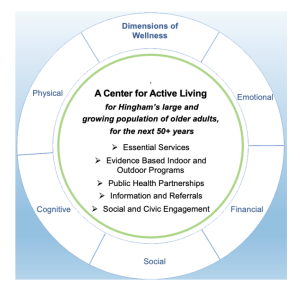
The benefits of an adequate and accessible Center for Active Living (CAL) at Bare Cove Park Drive are profound and far reaching— improved health outcomes and economic stability for residents, the community, and healthcare systems. There are costs and risks associated with not building the proposed CAL.
Key takeaways
● A Center for Active Living is an essential resource and foundation of an age friendly community. Hingham’s CAL, formerly the Senior Center, has been a historic Hingham resource since the first Center opened in 1971, 55 years of history. Growth in the U.S. network of 11,000 + Centers was sparked by funding made available by the enactment of the Older Americans Act (OAA) in 1965.
● Hingham’s CAL is no longer adequate, and lacks accessibility, and modern features. From the year the CAL opened at Town Hall in 1997, the share of residents age 60+ nearly doubled from 17% to 32% in 2025.
● The need for a bigger CAL was identified by the COA in 2011. With known projections, the Council on Aging initiated planning for an adequate center 15 years ago.
● A 15-year path of advocacy, investment, research, and community planning informed the CAL Building Project and has culminated in a significant opportunity to implement an essential healthy aging initiative.
● A solution, a significant and unique opportunity exists to build a new CAL at Bare Cove Park Drive. Approval of the site recognizes the complementary and impactful missions of both National Park Service (NPS) and the CAL in promoting civic engagement, social engagement, and wellness across the lifespan, through evidence-based programming.
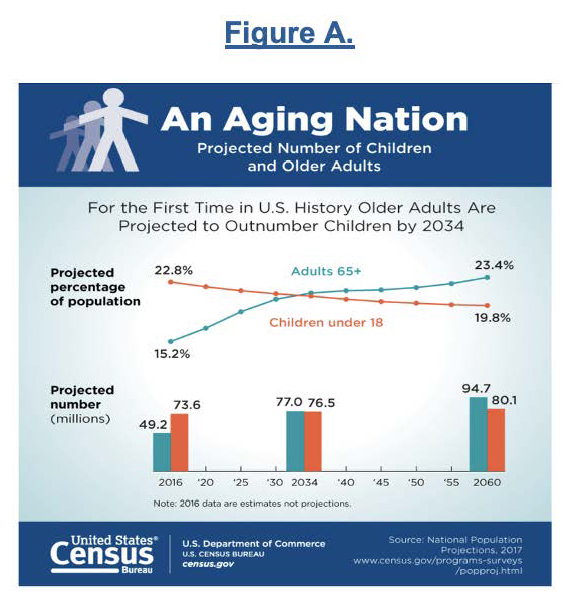
● The timing matters– it’s the era of aging. The time is now. It is a pivotal time for community planning related to aging in Hingham, and across the country. By 2030, for the first time in the country’s history, the share of people over age 60 will outnumber the share under age 18.
● Epic demographic shifts will continue for decades. (See figures A. and B.) Many towns, including Hingham (where the 60+ population is larger than the state average) have already reached this historic milestone. Today, 11,400 (46%) of Hingham residents are age 50+; close to 8,000 (32%) of residents are age 60+. An estimate of close to 10,000 Hingham residents will be over age 60 soon after the estimated opening of the proposed Center. By 2035, the share of Hingham’s 60+ population is projected to reach close to 40%.
● Substantial limitations will increasingly inhibit the CAL’s operations and contribute to missed opportunities that reflect unrealized impact related to physical, emotional, financial, and social health.
● Each of us is aging. Aging is a community experience. The CAL is an essential resource with a rippling impact on the community. The proposed CAL will become an implementation site for indoor and outdoor evidence-based health promoting programs; information and essential services; civic engagement; and social engagement that fosters wellness, inclusion, and quality of life in the community.
● The proposed CAL will ensure that this essential resource is in place for the next 50+ years, a historic time of living and aging in Hingham.
● Please read on to learn more about the heart of this project – the far-reaching benefits; and profound opportunity costs associated with waiting. Another year will be years longer, with increasing risk of adverse outcomes on the path of missed opportunities.
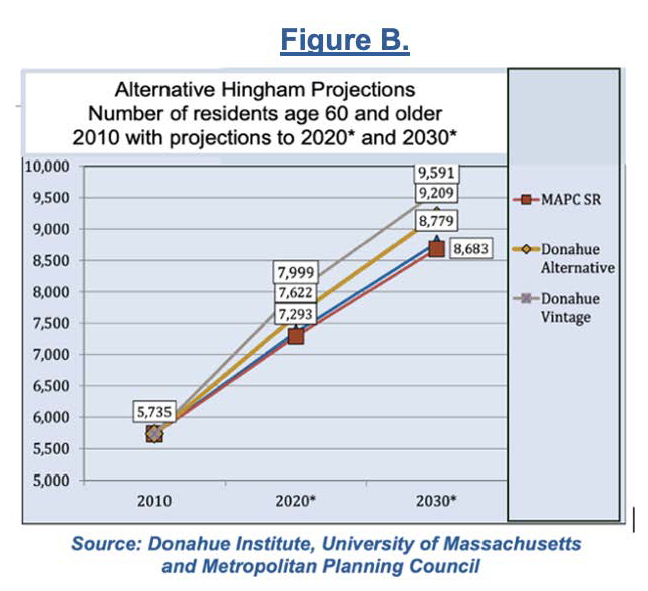
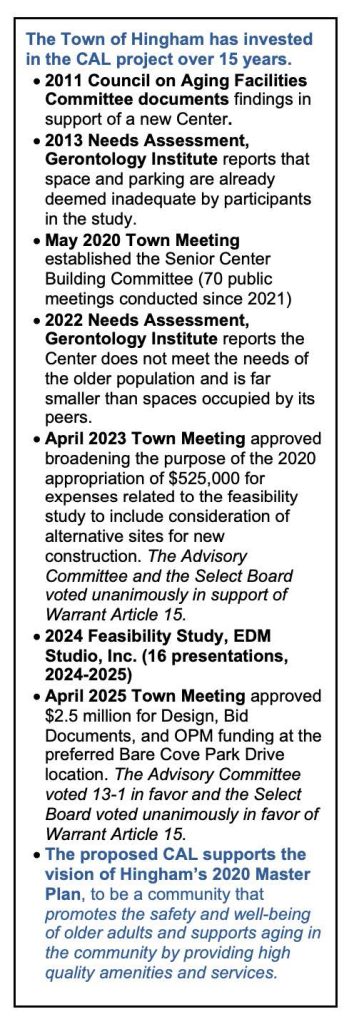 For close to 15 years, I have volunteered in support of initiatives that relate to Hingham’s substantial and growing population of older adults, alongside countless dedicated and talented advocates. In 2012, as a new member of the Council on Aging, I was informed of limitations and evolving plans to expand or build a new Center. A Facilities Committee had been established in 2011, and members were conducting visits to learn best practices from peer communities. A 2012 report from the committee stated, “looking at the future senior population based on projections provided by the MAPC, the town of Hingham will have an age 60+ population of 8,500 in 2030”. (Today, there are close to 8,000 residents over age 60.) Based on projections, the 2012 report proposed a range of 32,000 SF– 39,000 SF Center for the goal of initiating construction by 2020. (39,000 SF was calculated to reflect growth through 2030.) Today, the community is nearing Town Meeting 2026, a pivotal crossroads, with a significant opportunity to build an adequate (and smaller than proposed in 2012) Center for Active Living. In light of questions and varying levels of awareness, I am sharing key facts and findings to provide context and clarity for continuing conversations; and to deepen understanding and support for the proposed Center for Active Living.
At the heart of the CAL Building Project is a resource that exists to promote wellness and provide relief in times of hardship by addressing Social Determinants of Health (SDOH) through affordable, accessible, and adequate community-based health promoting programs and services. Through its skilled staff, and through collaboration with local stakeholders, including emergency responders and healthcare providers, a Center of Active Living aspires to identify and respond to needs in the community, while also serving as an efficient and economical form of preventative healthcare.
The CAL relates through the journey of aging…through the individual experience of aging (for you, your future self), and the family and community experiences of aging. Younger residents often engage in a CAL through volunteerism, mutually rewarding intergenerational programs, or as caregivers seeking information and supportive services for loved ones.
Research and personal stories demonstrate that community based healthy aging initiatives contribute to improved health outcomes and economic stability for residents, the community, and healthcare systems. According to the National Council on Aging, older adults who participate in programs at a Center for Active Living can learn to manage and delay the onset of chronic disease and experience measurable improvements in their physical, cognitive, emotional, and economic well-being. As well, there is extensive research on the mutually rewarding benefits of civic and social engagement. Reported benefits, across generations, include sense of belonging; reduced levels of isolation; increased sense of purpose; and fulfillment derived from mentoring, and educational opportunities.
An adequate Center will accommodate (what have been missed) opportunities to implement additional health promoting evidence-based programs. The CAL has conducted evidence-based programs in the past but has been inhibited in developing a more robust and diverse schedule due to space constraints; as well, inadequate space has impacted eligibility for grant funded programs. The National Council on Aging guides communities in offering proven programs that promote aging in place, quality of life, fewer medical visits, and improved health outcomes at the individual level; while simultaneously yielding cost savings for residents, the community, and healthcare systems.
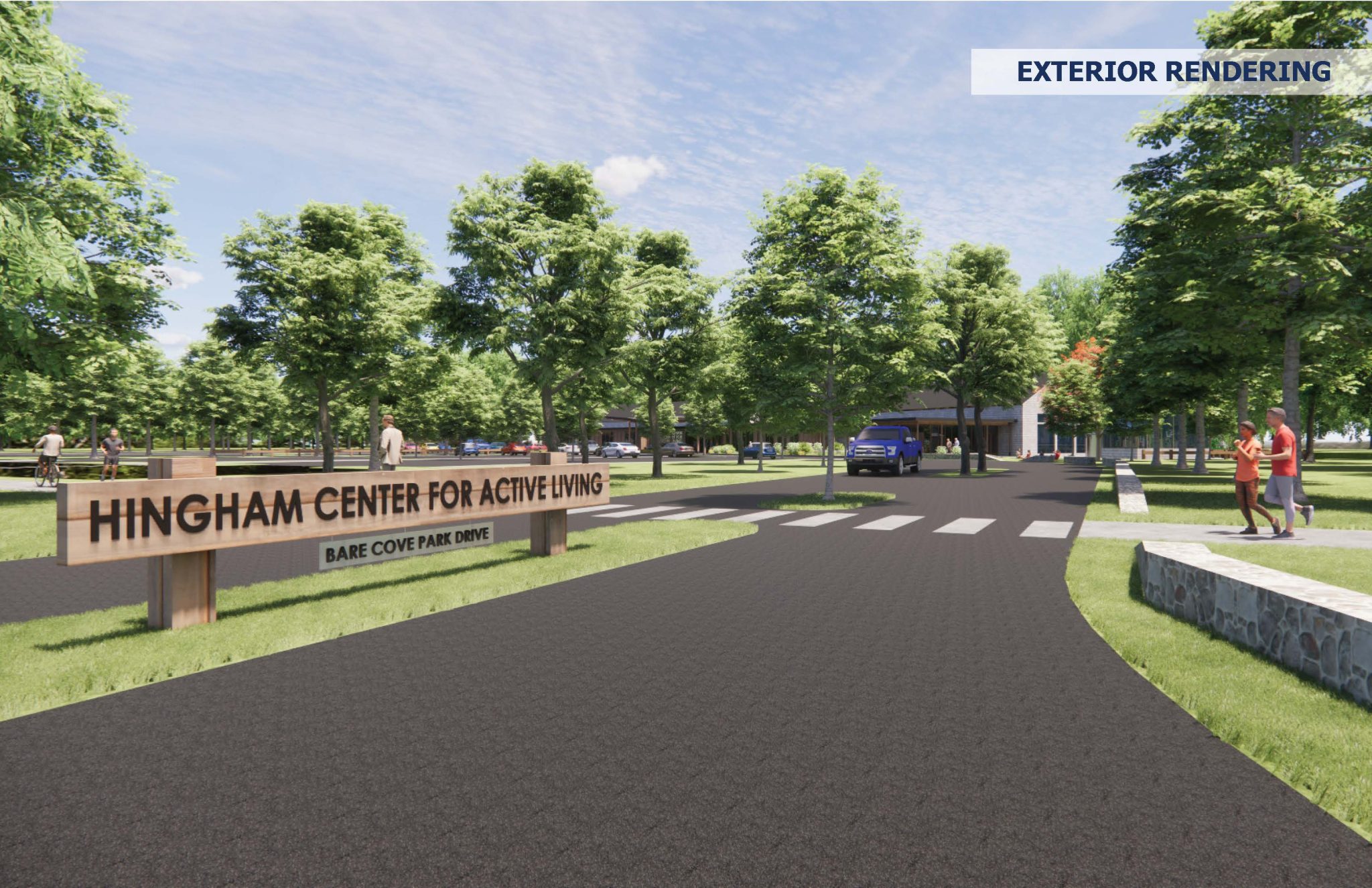
There is synergy at the site on Bare Cove Park Drive. The site of the proposed Center for Active Living, near the entrance of Bare Cove Park and recreation fields, offers tremendous opportunities for evidence based indoor and outdoor programming. The site is a portion (close to 1%) of 460+ acres of land that was acquired by the town in 1972 under the National Park Service Federal Lands to Parks (FLP) program. The NPS-FLP program is described as an opportunity for “communities throughout the nation to renew a sense of community among neighbors through community gardens, senior and cultural centers, local parks, and other gathering places.” For decades, National Park Service (NPS), through its Healthy Parks Healthy People initiative and the National Recreation and Park Association’s Healthy Aging in Parks initiative have demonstrated the impact of parks and recreation agencies in promoting health through the development of outdoor evidence-based programs. The CAL project also provides meaningful opportunities for the community of Hingham to leverage the guidance of NPS in continuing to develop programs and practices that foster environmental stewardship through community partnerships, education, and volunteerism.
Social Determinants of Health (SDOH) have a strong impact on our health, well-being, and quality of life — and affect our chances of staying healthy as we age. Modernized Centers for Active Living function as a Social Determinant of Health by providing essential services, evidence-based programs, and social connections across the lifespan.
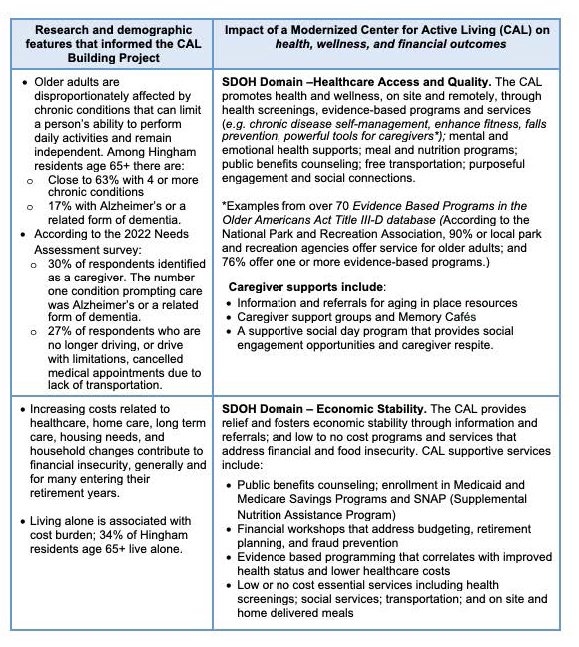
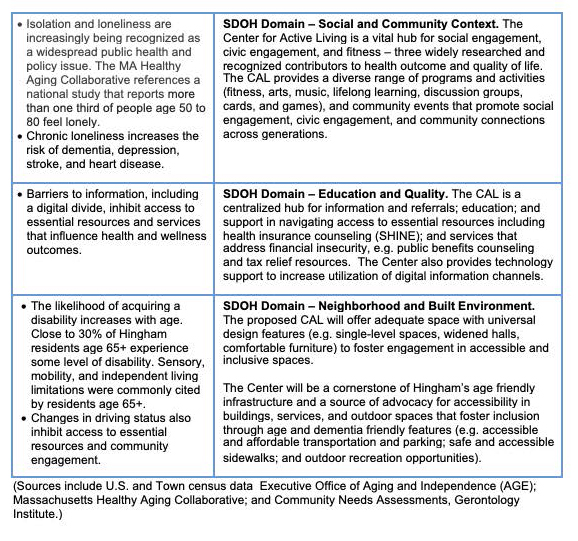
There are costs associated with delaying the project or reducing the size of the CAL as Hingham’s large and growing older population grows. Amidst otherwise strong agreement during public discussions that a larger CAL is necessary in Hingham, cost concerns have been acknowledged. Diligent efforts have been made to reduce costs through value engineering, while not compromising the benefits associated with an adequately sized and accessible Center. The size of the proposed CAL was reduced from 28,000 to 26,950 SF in August 2025. The proposed building is reasonably sized, and smaller than the Centers in South Shore peer communities. Soon after the estimated completion date of the proposed CAL, with 2030 60+ population projections –that remove Linden Ponds data–the proposed CAL would still be smaller than the 2025 average SF/ resident 60+ that was calculated for the Centers in Cohasset, Duxbury, Marshfield, and Scituate. Because of fixed costs, further reductions in size will not produce linear cost savings.
Inadequate space will inhibit the CAL in expanding essential evidence-based health promoting programs and services; obtaining program specific grant funds; building participation levels among thousands of adult residents; and fostering intergenerational engagement and community wide connections. (See Funding and Participation Guidelines below.) Inadequate space will inhibit utilization and the CAL’s impact on individual and community health. Communities that have undergone renovation or expansion, are drawing participation from over 40% of their age 60+ populations, demonstrating that adequate and appealing spaces drive higher levels of utilization and community impact associated with improved health status, quality of life, and financial security.
Funding and Participation Guidelines. Programs and services are prioritized for residents age 60+. (The Commonwealth of MA considers individuals age 60+ to be an older adult for the purpose of calculating the level of funding that will be distributed to Councils on Aging in each municipality.) In addition to the municipal budget, grant funding; fundraising by the Friends of the COA; business and personal donations; volunteers; and programs fees support the CAL. The proposed CAL will be open five days a week; the Center’s participation policy (below) has historically remained unchanged.
● Residents age 60 and over will continue to have prioritized access to programs and services at the Center for Active Living.
● Registered Adult Residents under age 60 will continue to be welcome in programs, as space allows.
● Residents under age 18: Intergenerational programs will continue to be offered as space and schedules allow; and will evolve at the proposed CAL.
A 15-year path brings the community to a transformative milestone at Town Meeting 2026. The population of older adults will continue to grow for decades. Now is the time to ensure that an adequate Center for Active Living will remain a cornerstone of the community for the next 50+ years, a historic time of living and aging in historic Hingham.
For more information, including past studies, presentations, and a detailed overview of programs and services, please visit the Center for Living Project website via the link below.
https://www.hingham-ma.gov/353/Center-for-Active-Living
A tax impact calculator is available on the Town of Hingham website as a tool for residents to calculate the tax impact associated with their property here: Tax Impact Estimator | Hingham, MA
Please submit questions and comments by sending an email to HCALProject@hingham-ma.gov
This whole thing is just dumb and unnecessary. I hope the residents will vote this down.
“Interwoven dimensions of wellness” is all I need to hear to know that this is a big load of nonsense. Keep the existing Senior Center, it’s surplus to needs as is.